
Embroidery · Guide
Embroidered Home Decor: 6 Ideas to Make or Buy
Six ways to bring embroidery into a room, and how to choose a piece that suits the spot and the way it will be used.
The short answer
The easiest embroidered pieces to live with are a framed or hoop wall piece, a pillow cover that zips off, and a cotton or linen table runner. Whether you buy or stitch, check the fiber and how the piece is cleaned, and keep it out of direct sun. For highly light-sensitive dyes, such as many natural dyes, Canadian Conservation Institute estimates put a first visible fade near a bright window at days to weeks.
Swipe sideways
| Piece | Look | Fabric, thread, backing | Care and wear |
|---|---|---|---|
| Hoop or framed wall piece | Florals, lettering, samplers | Stable cotton or linen, Aida for cross stitch; stranded cotton floss | Rarely washed. Hang out of the sun; frame with a spacer |
| Pillow cover | A focal point on a sofa or bed | Medium-weight woven cotton or linen with a zip or envelope back | Removable cover with clear cleaning instructions |
| Table runner, napkins | Matching table sets, monograms | Washable cotton or linen; colorfast floss | Washed often: test the colors first |
| Towels | Guest and kitchen towels, initials | Prewashed terry; fill designs; for machine work, tear-away backing plus a water-soluble topper | Frequent washes; if you bleach, thread and towel must both take it |
| Curtains, sheers | Pattern against the light | Washable light or sheer fabric; for machine work, a water-soluble stabilizer, tested first | Possibly high light exposure; fading depends on window, dye and hours of sun |
| Upholstery, patchwork seats | A statement chair or sofa | Upholstery fabric with a published rub count | Check the cleaning code before you buy |
These pairings are starting points, not recipes. Madeira says even its own backing suggestions are no guarantee and asks you to test on a similar fabric, so stitch a small test piece first.
Embroidered home decor ideas, piece by piece
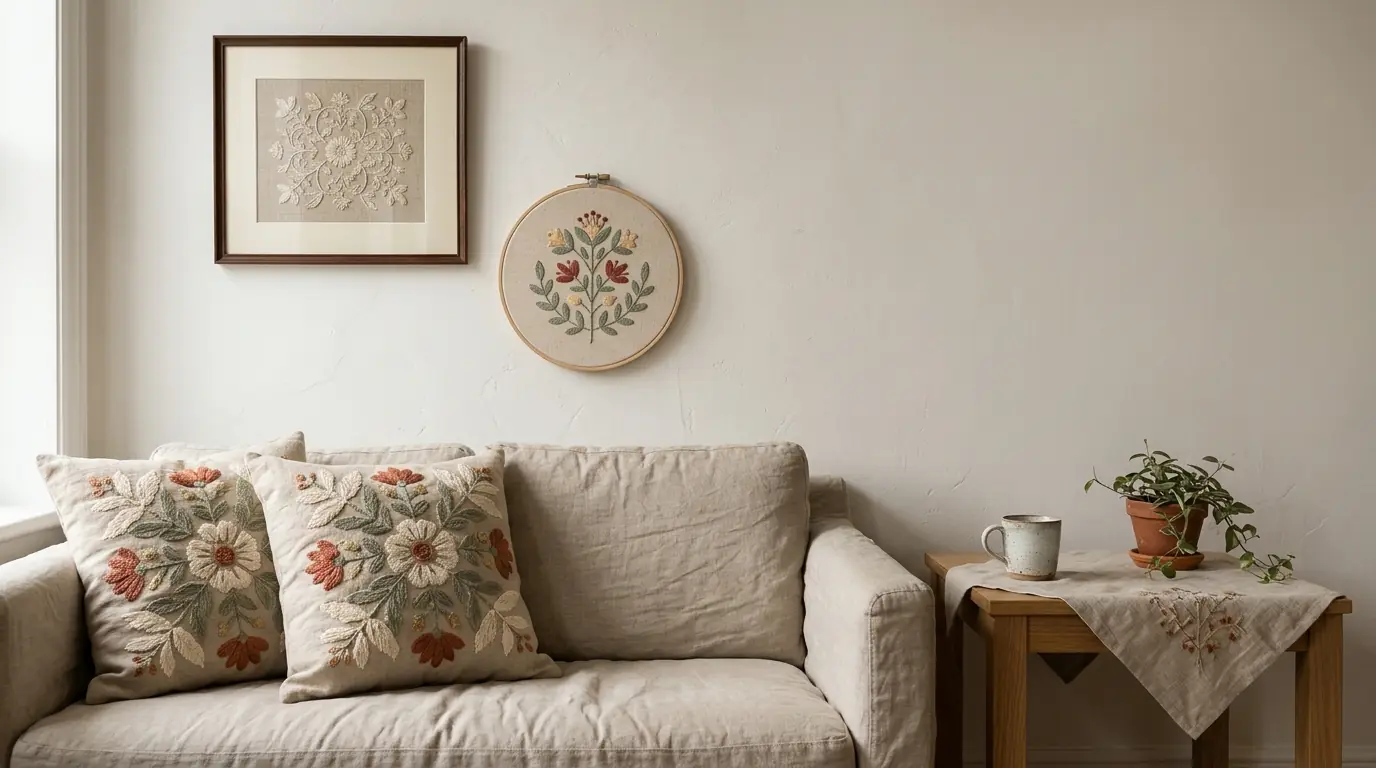
Embroidery works in almost any style: florals soften a plain sofa or wall, monograms suit towels and napkins, white-on-white whitework stays quiet on linen, samplers bring pattern and lettering, and embroidered or appliquéd patchwork makes one bold piece.
Wall pieces: hoop art, frames and cross-stitch hangings
A wall piece is the easiest first project. Nobody sits on it, and it rarely needs washing, so almost any stable fabric and floss will do. For a first piece, pick a small line motif on stable woven cotton and work it in back stitch or stem stitch, the outline stitches in DMC’s stitch guide. Practice on a scrap, then transfer the design, hoop the fabric, stitch, then finish the piece for display.
If the piece will stay in its hoop, pick the hoop by the design before you start, so the motif sits centered. For a cross-stitch wall hanging, work out the fabric size from your stitch count first. Three hoops of different sizes, stitched in the same two or three thread colors, read as one set on a wall.
Release the working hoop between stitching sessions: DMC warns that leaving work in the hoop for an extended period can cause creases that are difficult to remove. A finished piece can go into a separate display hoop. For an heirloom, a frame with a fabric-covered mount is the gentler long-term home (see below).
Pillow covers
A single motif can make a plain pillow cover the focal point of a sofa. Cut a paper template at the finished design size, pin it to the pillow and look at it from across the room. Keep the design clear of the seams, and check how it looks once the pillow is filled. To tie a room together, repeat a wall piece’s botanical motif on one pillow, larger, in the same thread colors.
Pick a cover that opens, with a zip or an envelope back, and check that the opening lets you position the hoop and keep every other layer clear of the needle. Some ready-made covers need a seam opened, so embroidering the front panel before assembly is usually simpler. A zip alone does not make a cover washable: choose one with explicit cleaning instructions, and for one you make, a cleaning method that suits the fabric, thread, backing and trims.
For machine embroidery on a stretchy knit, Sulky’s general rule is a permanent cut-away backing; on wovens, a tear-away. If you would rather crochet, crochet pillow patterns are covered separately.
Table runners and napkins
Table linens and towels are the pieces you will wash most often, so they decide the thread. DMC says the colorfast dyes in its Mouliné Spécial floss let the work be washed “without fear of the color fading or bleeding.” For machine work, Madeira sells its Classic Rayon for items washed with detergent but without bleach, whiteners or brighteners. If your tablecloths get bleached, its Polyneon polyester is made to resist chlorine bleach; the thread alone does not make the cloth or the other colors bleach-safe, so check those too.
Linen suits the job, but folding wears it: the Canadian Conservation Institute notes that repeated sharp creases break linen fibers over time. Store runners rolled, or fold napkins along a different line now and then. A small monogram in one corner, placed to show when the napkin is folded, is enough to make a set.
Towels
Terry loops swallow fine stitching. Sulky’s advice for towels: machine wash and dry them first, ready-made towels included. Choose fill or appliqué designs over line work such as redwork, which gets lost in the texture. On a guest towel, center initials above the woven band near the hem, where they show when it hangs folded.
Underneath, Sulky’s blog suggests one or two layers of tear-away; on top, a water-soluble topper such as Solvy keeps the loops from poking through. For a more decorative towel, Sulky suggests a permanent backing so the design does not “ball up” in the wash.
Curtains and sheer panels
How fast curtains fade depends on the window, the dye and the hours of sun. In the Canadian Conservation Institute’s light table, the most light-sensitive dyes, such as many plant dyes and low-quality synthetic colors, show a first visible fade after 4 days to 1 month at 5,000 lux, its example for light from a window, counting 8 hours a day; direct sun is far brighter. Colors also change unevenly rather than simply growing paler, because some shift hue as their less stable parts fade, CCI notes. Choose a window without direct sun rather than counting on a graceful fade. A border along the hem or the leading edge shows best, as light from behind turns it into a silhouette.
On washable sheers, Sulky lists water-soluble stabilizer, which washes out after stitching. Test it on a scrap with a light design, and check that the fabric takes the rinsing water and the stitching holds once the support is gone. Madeira says its Classic Rayon is not suitable for outdoor items and should be kept out of excessive sun. For the fabric, CCI ranks flax, the fiber in linen, as the most light-resistant natural fiber and silk as the least.
Embroidered and patchwork upholstery
A sofa or chair covered in embroidered fabric, or in patchwork with embroidered or appliquéd patches, is the boldest piece here and has the hardest life. Among plain pieces, one such chair can set the palette for the pillows around it. A delicate embroidered panel can still work on a chair back or a bolster, where nobody sits on it.
Fabric makers in the UK and Europe quote the Martindale test (BS EN ISO 12947); US makers usually quote Wyzenbeek “double rubs,” and some, such as Pollack, give both. The fabric maker Kothea warns that the two are not directly comparable.

Kothea puts its “decorative” class, under 10,000 Martindale cycles, on cushions and throws, and everyday sofas at 15,000 to 25,000. Pollack rates fabric under 15,000 Wyzenbeek double rubs for pillows and chair backs, and 30,000 to 50,000 or more for family room sofas.
A rub count is one number, not the whole answer. Ask whether it applies to the finished embroidered fabric or only its base cloth; a base-fabric rating says nothing about the added stitches. Kothea notes that a rub count leaves out light fastness, pilling, stains and pet claws. The Association for Contract Textiles adds that both tests measure flat abrasion only, and that higher numbers do not necessarily mean a longer life.
Pallas Textiles’ cleaning codes apply to the outer fabric only: W means water-based upholstery shampoo or foam, S dry-cleaning solvent only, WS either, and X vacuuming or light brushing only. For W, S and WS fabrics, Pallas says cushion covers should not be removed and laundered or dry cleaned, so a zip does not make a seat cover washable. Pre-test any cleaner on a hidden spot.
Patchwork adds checks, because every patch can be a different fabric. Vintage or reclaimed patches have unknown fibers and dyes, so the per-color spot test below matters even more, and CCI lists multi-fabric quilts among the historic textiles that should never be washed: when in doubt, vacuum a patchwork cushion or spot clean it by its code. Velvet pile crushes easily, needlepoint stretched over a seat can tear when humidity swings from moderate to high, and beads and sequins hang on threads that weaken with use.
Hand or machine embroidery?
Machines differ in capability and setup, so check your manual.
- Hand embroidery suits single motifs, lettering and texture. What matters is even tension: DMC says loose stitches look limp, and stitches pulled too tight pucker the fabric.
- Counted cross stitch suits charted designs, samplers and lettering on Aida.
- Programmed machine embroidery is faster for repeats such as a set of monogrammed napkins, but the design has to fit the machine’s sewing field.
- Free-motion embroidery draws lines with thread on an ordinary sewing machine: Bernina describes lowering the feed dog and moving the fabric yourself, and says it can be sewn on almost any machine.
Whichever you use, match floss colors in good light; a high-CRI lamp shows them closer to daylight.
Make it or buy it
Make it when you want your own motif and want to choose the fabric, the thread and the way it is cleaned yourself.
Buy it for a large piece, such as a sofa or full-length curtains, or a technique you do not stitch yourself. For seats, buying upholstery fabric with a published rub count is simpler than stitching enough yardage yourself. The “Before you buy or stitch” checklist near the end sums up what to ask.
How to judge a finished piece
Ask for close-ups of the front and the back before you buy. The fabric around the stitches should lie flat, the edges should be secure, and there should be no unintended loose loops; the puckering and limp stitches described above are flaws, not texture. The back does not have to be immaculate.
Follow specific hand-washing instructions from the maker (for fiber labels, see below). If there are none, first find out whether the whole piece can take water at all before you think about a colorfastness test.
Beads, sequins and raised stitches look best where hands and bodies do not rub them: on wall pieces, bolsters and chair backs.
Plan the washing before you stitch
For a washable project, prewash and dry the fabric or blank as its care instructions allow; never wash anything whose instructions forbid it. The Canadian Conservation Institute warns that shrinkage is irreversible and that loose weaves shrink in washing and drying.
A clean color test does not prove the whole piece is washable: CCI treats it as one of many factors, and never washes historic pieces with trims, beads or sequins or of mixed materials. Its spot test, from CCI Notes 13/14:
- Put a drop of purified (distilled) water at the planned wash temperature on a hidden spot, such as the back of the embroidery.
- Cover it with white blotting paper or prewashed white cotton and a light weight.
- Check after a few seconds, then after 2, 5, 15 and 30 minutes.
- Test every color, including the thread on any old repairs.
- If no color moved, repeat the test on the same spot with your detergent diluted as for the wash and at the wash temperature, then rinse the spot with purified water and blot it dry.
If any color moves onto the paper, do not wash the piece. Dyes can still run in a full wash after a clean test, CCI adds, and the test itself can mark the fabric, so use a hidden spot or a leftover stitched sample.
If bought decor has no cleaning instructions, ask the maker; the FTC Care Labeling Rule covers clothing and fabric for home-sewn clothing, not household decor. Towels, table linens, curtains, cushions, throws and slipcovers sold in the US must name their fiber content, but embroidery covering no more than 15 percent of the surface can be left off, so ask about the thread. Wall decorations fall outside the Textile Act, though one that contains wool is covered by the Wool Act; the outer fabric of upholstered furniture is exempt under both.
Keep wall pieces from fading
Light damage adds up and cannot be undone, the Canadian Conservation Institute says, and all of light contributes, not only UV. Most white LEDs give off no UV, but bright light of any kind still fades color.

These estimates illustrate highly light-sensitive colorants; they do not predict the life of a particular modern embroidery thread. The lever that matters most is how much light reaches the piece. In CCI’s guide, cutting light from 5,000 to 50 lux makes colors last about 100 times longer. Your stash fades the same way: keep thread behind a lid, and see the same CCI numbers for stored fabric. Museums display textiles for limited periods, with CCI giving a three-month maximum as an example; at home, rotate a favorite piece with others rather than leaving it in one bright spot.
Frame it so nothing touches the stitches
CCI’s framing note covers “contemporary needlecraft intended for home display” as well as museum pieces. Clean the piece first, for most embroideries by vacuuming through a screen (see Dusting embroidery below); white, undyed work such as whitework in good condition can also be washed gently. The embroidery is then mounted on a fabric-covered board. A spacer, either a window mat or thin strips, holds the glazing slightly off the stitches. That keeps raised stitches from being crushed and lowers the risk of condensation on the glass.

UV-filtering glass or acrylic gives some protection, but CCI says it is not complete, so the room’s light still matters. Glass is heavier and breaks more easily; acrylic scratches more easily and can build enough static to pull loose fibers.
Nothing acidic or sticky should touch the fabric. That rules out acidic card and mat board, unsealed wood, glue, tape, adhesive boards, sprays of any kind, including protective sprays, and staples, tacks and nails. The old way of tacking samplers to wooden boards left holes, uneven tension and rust stains. CCI also notes that ordinary framing is acceptable when long-term preservation is not the goal, so decide first whether the piece is decor or an heirloom.
Where to hang it
Avoid spots the sun reaches at any time of day. CCI also lists fireplaces, radiators and heating vents, and the exterior walls of unheated buildings, as places to avoid. Do not fix a picture light to the frame itself: CCI says such fixtures produce excessive light levels in one spot.
Damp is the other risk: CCI puts mold at three months or more at 70% relative humidity and only a few days at 90%, and singles out air trapped behind a textile on a cold exterior wall as a high-risk spot. For off-season linens, see how to store fabric away from light, dust and damp.
Dusting embroidery
Vacuum only pieces in sound condition: CCI rules out fragile or powdering textiles and those with broken threads or loose beads, sequins or feathers. Lay the piece flat on a clean surface covered with prewashed cotton sheeting or acid-free tissue. CCI vacuums through nylon or polyethylene screening of 18 to 20 mesh with cotton tape sewn over the cut edges, with a HEPA or canister vacuum (never an upright or a beater bar) turned down until the dirt lifts but the fabric does not. Do not press the nozzle down: “suction removes the dirt, not pressure.” Then do the back.
Before you buy or stitch
Questions people ask
Can embroidered decor go outside?
Only with materials made for it, because sun does two different things. UV weakens the fibers themselves, and light fades the dyes. For fiber strength, the Canadian Conservation Institute rates nylon poor in sunlight and acrylic good; for the thread, Madeira says its Classic Rayon is not suitable for outdoor items.
How can I tell whether an embroidery has faded?
Compare the front with the back: the Canadian Conservation Institute says comparing exposed and protected areas, such as the front and back of an embroidery, shows fading best.
Can I make embroidered decor without a machine?
Yes. Wall pieces, pillow covers and napkins are classic hand-embroidery projects; a machine is faster for repeats, such as one monogram on a set of napkins.
Can I embroider a ready-made pillow cover?
Yes, if its care label allows the washing you plan; prewash it first if it is washable. If you cannot reach the front without catching the back, unpick part of a seam and close it again afterwards.
Sources
- DMC: Mouliné Spécial six-strand embroidery floss, product page. Colorfast dyes so work can be washed without the color fading or bleeding; highly fade resistant dyes; 8.7 yd (8 m) skeins, six strands. Retrieved 2026-11-13
- DMC: How to use an embroidery hoop. Do not leave work in the hoop for an extended period, it can cause creases that are difficult to remove; loose stitches look limp, too-tight stitches pucker the fabric. Retrieved 2026-11-13
- Madeira USA: Classic Rayon. For items normally laundered with detergent without whiteners, brighteners or bleach; avoid bleach, dry cleaning or excessive sun; not suitable for harsh commercial laundering, bleaching or outdoor items. Retrieved 2026-11-13
- Madeira USA: Polyneon polyester embroidery thread. Colors resistant to chlorine bleach; made for uniforms, safety garments and commercial linens. Retrieved 2026-11-13
- Sulky blog: The Stabilizer Series, your questions answered. In general tear-away for wovens and a permanent stabilizer for knits; bath towels 1 to 2 layers of Tear-Easy with Solvy as a topper; a permanent stabilizer for a decorative towel to keep the design from balling up in the wash. Retrieved 2026-11-13
- Sulky blog: 10 water-soluble stabilizer FAQs. Tear-away for woven fabrics, cut-away for stretchy fabrics, not carved in stone; Solvy and Super Solvy as a topper on napped fabrics like towels; used for lightweight and sheer fabrics. Retrieved 2026-11-13
- Sulky blog: Machine embroidery series, terry cloth. Machine wash and dry terry, pre-made items included, before embroidering; line designs such as redwork get lost in the texture, fill or appliqué designs work better. Retrieved 2026-11-13
- Madeira USA: E-Zee backing and topping selection guide. Suggestions are no guarantee; test on a similar fabric. Retrieved 2026-11-13
- eCFR: 16 CFR Part 423, FTC Care Labeling Rule. §§ 423.1 and 423.3: care instructions required for textile wearing apparel and for piece goods sold to make home-sewn apparel. Retrieved 2026-11-13
- eCFR: 16 CFR 303.45, Textile Act rules, products covered. Fiber labels required on towels, tablecloths and napkins, curtains and draperies, cushions, afghans and throws, furniture slip covers and bedding; items not listed are excluded, as are secondhand household textiles marked or discernibly secondhand. Retrieved 2026-11-13
- FTC: Threading Your Way Through the Labeling Requirements Under the Textile and Wool Acts (business guide, govinfo copy). Labels must list fiber content, country of origin and the responsible business; wall decorations and outer coverings of upholstered furniture are not covered by the Textile Act; decorative trim applied by embroidery is excluded from labeling if it does not exceed 15 percent of the surface area; products with any wool are covered by the Wool Act, upholsteries excepted. Retrieved 2026-11-13
- Canadian Conservation Institute: Caring for textiles and costumes (revised 2024). Light damage is cumulative and irreversible; high sensitivity (ISO Blue Wool 1, 2 or 3) includes most plant extracts and many low-quality synthetic colourants; of the natural fibres flax resists light best and silk worst, acrylic is the most resistant manufactured fibre and nylon among the least; UV absent in most white LEDs; Table 4, most light-sensitive colors, just noticeable fade at 30,000 lux in 0.8 to 7 days (1 to 14 days without UV), at 5,000 lux, light from a window or study lamp, in 4 days to 1 month (5 days to 2 months), at 500 lux in 5 weeks to 1 year (7 weeks to 2 years), at 150 lux in 20 weeks to 3.5 years (6 months to 7 years), at 50 lux in 1 to 10 years (1.5 to 20 years), 8 hours a day; cutting light from 5,000 to 50 lux prolongs colors by a factor of 100; flax most light-resistant natural fiber, silk least; nylon poor in sunlight, acrylic good; shrinkage irreversible; repeated sharp creases break linen fibers; some colours change hue as the more fugitive components fade; UV weakens fibres, visible light fades dyes; velvet pile crushes; needlepoint on an upholstered seat may tear when humidity swings; mold in 3 months at 70% RH, a few days at 90%; textiles on cold exterior walls; display for limited periods, e.g. a three-month maximum. Retrieved 2026-11-13
- Canadian Conservation Institute: CCI Notes 13/14, Testing for Colourfastness. Colourfastness is just one of many factors before wet cleaning; never wash items with trims, beads or sequins or composite artifacts; drop of purified water at the proposed wash temperature on a hidden area such as the back of an embroidery, blotting paper and a light weight, checks after a few seconds, 2, 5, 15 and 30 minutes; test every color; if no color moved with purified water, test with the detergent solution at the proposed wash concentration and temperature, then rinse with purified water and blot dry; the test may damage the test area; multi-fabric quilts are among textiles that should never be washed; any color movement means do not wash; dyes may still run unexpectedly. Retrieved 2026-11-13
- Canadian Conservation Institute: CCI Notes 13/16, Mechanical Surface Cleaning of Textiles. Assess condition first, not for fragile or powdering textiles; place the textile on a clean flat surface covered with acid-free tissue or prewashed cotton sheeting; adjust suction so dirt is removed without lifting the textile; clean the reverse side too; low suction through nylon or polyethylene screening of 18 to 20 mesh with cotton tape sewn over the cut edges; suction removes the dirt, not pressure; do not press the nozzle down; no upright vacuums or beater bars; not for loose beads or sequins. Retrieved 2026-11-13
- Canadian Conservation Institute: CCI Notes 13/17, Conservation Framing of Embroideries and Other Flat Textiles. Applies to needlecraft for home display; clean textiles before mounting, for most by mechanical surface cleaning; non-coloured textiles such as whitework in good condition can be gently washed; mount on a fabric-covered support; spacers keep glazing off the stitches; UV-filtering glazing protects only partly; no acidic board, unsealed wood, glue, tape, sprays, staples or tacks against the textile; avoid sun, fireplaces, radiators, heating vents and exterior walls of unheated buildings. Retrieved 2026-11-13
- Kothea: Martindale rub test, designer's worksheet (PDF). BS EN ISO 12947; Wyzenbeek double rubs not directly comparable; decorative under 10,000 cycles for cushions and throws, general domestic 15,000 to 25,000 for everyday sofas, heavy domestic 25,000 to 40,000; the rub count does not measure light fastness, pilling, staining or pet claws. Retrieved 2026-11-13
- Pollack: Abrasion results and recommended use. Light upholstery, pillows and chair backs, under 15,000 Wyzenbeek double rubs; medium 15,000 to 30,000+; heavy, family room sofas, 30,000 to 50,000+ double rubs or 40,000 Martindale cycles. Retrieved 2026-11-13
- ACT, Association for Contract Textiles: Abrasion disclaimer. Wyzenbeek and Martindale measure flat abrasion only, not edge abrasion; field failures are far more likely from inappropriate cleaning, lack of maintenance, physical abuse or inappropriate application; higher numbers do not necessarily mean longer life. Retrieved 2026-11-13
- Bernina blog: Free-motion embroidery with the sewing machine (2022). Can be sewn on almost any machine; the feed dog is lowered and the material is moved; test settings on a sample with stabilizer. Retrieved 2026-11-13
- DMC: Step by step embroidery stitch guide. Back stitch, an essential flat stitch giving a continuous line, very useful for outlines; stem stitch, very popular for lettering and outlines. Retrieved 2026-11-13
- Pallas Textiles: Upholstery maintenance and cleaning guide (PDF). Cleaning codes W, S, WS and X apply to the outer fabric only; with W, S and WS, cushion covers should not be removed and laundered or dry cleaned; pre-test on a hidden area. Retrieved 2026-11-13