
Craft room · Guide
Craft Room Storage Ideas: 20 Ways to Store Fabric, Yarn & Thread
Twenty storage ideas for a craft room or sewing corner, each with one rule that keeps your stash from fading, molding or feeding moths.
The short answer
Store craft supplies by what damages them. Fabric, yarn and floss fade in light, so keep them in closed cabinets, lidded boxes or drawers. Keep the room dry and cool: mould can start in about 3 months at 70% relative humidity. Protect wool from moths with clean, sealed storage. Put daily tools within arm's reach and the long-term stash behind doors.
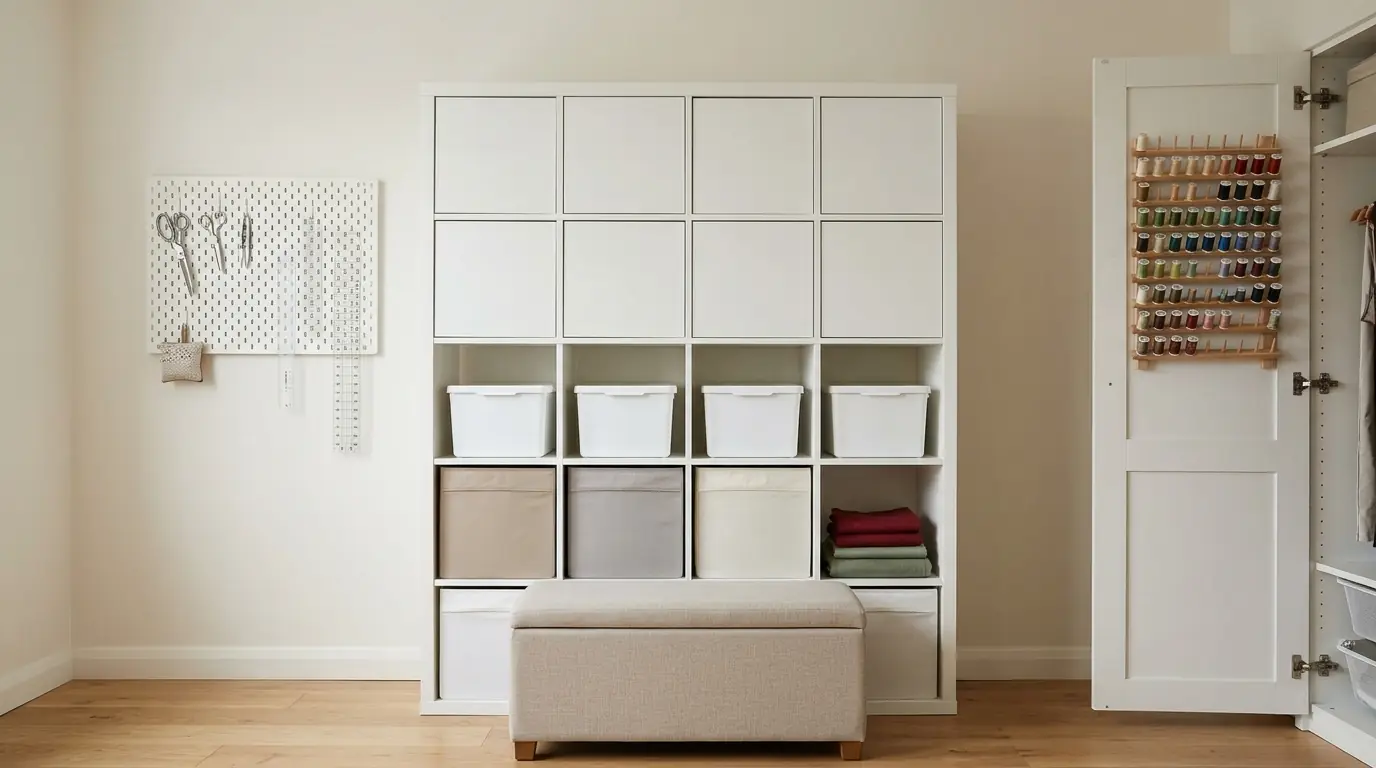
Most craft room storage ideas start with the container. A better starting point is the material: fabric, yarn, floss, tools and paper are damaged by different things. Museums and libraries have studied that for decades, and their advice scales down to a sewing corner. So here are twenty ideas, each with one rule. After that, we explain the rules with the numbers behind them.
20 craft room storage ideas that also protect your stash
Product data comes from maker or retailer pages; we have not used them ourselves.
- Cube shelf with door inserts. The IKEA KALLAX shelf unit is 30 1/8 x 57 5/8 in with eight cubes, rated for 29 lb per shelf. Add the KALLAX insert with door (13 x 13 in) for the stash. Rule: doors for the long-term stash, open cubes only for this season’s project, and anchor the unit to the wall.
- Lidded boxes inside the cubes. The IKEA KUGGIS storage box with lid is 12 1/2 in on each side, so it slides into a cube, and it is opaque white PET plastic, not PVC. Rule: opaque beats clear on an open shelf.
- Mini bolts. Fabric wrapped on boards reads like book spines. The Fat Quarter Shop Original Mini Bolts are acid-free and hold 1 to 15 yards each; the smaller fat quarter size takes pieces under 1 yard. Acid-free comic boards work the same way. Rule: stand bolts behind doors, because their exposed edges fade first.
- File-fold in drawers. Fold each piece to the drawer depth and stand it on edge, so you see every fabric from the top. Rule: refold along new lines now and then, because sharp creases can fracture fibers over time.
- Hanging-file cabinet. Hanging folders hold fat quarters, patterns and interfacing, a forum favorite on r/sewing and r/quilting. Rule: don’t pack folders tight, and keep a metal cabinet in a dry room.
- Multi-bar pants hangers. In a closet, a hanger like the IKEA GÅRDSMÄSTARE holds several lengths of woven yardage. Rule: pad each bar with tissue so the fold stays soft, and never hang knits, which stretch.
- Closet-to-sewing-nook conversion. A reach-in closet takes a narrow table, a shelf and bins; close the doors and it is dark and dust-free. Rule: pick a closet on an interior wall and check it for damp before you move in.
- Pegboard for tools. The IKEA SKÅDIS pegboard (30 x 22 in) keeps scissors and rulers in sight. Rule: tools and notions only, not fabric or yarn.
- Rolling cart. The IKEA RÅSKOG utility cart has lockable castors and takes 13 lb per tier. Rule: only the current project rides on it, and it parks out of the sun.
- Over-the-door pockets. A door back holds notions, zippers and patterns. Rule: choose cloth or polyethylene pockets, not PVC, whose plasticizers migrate, says the Canadian Conservation Institute (CCI).
- Lidded under-bed boxes. Under the bed is dark, which fabric likes. The Sterilite 32 Qt. ClearView Latch Box is 23 5/8 x 16 3/8 x 6 1/2 in and made to slide under a bed. Rule: dry, clean contents only, checked each season.
- Clear latching boxes in a closet. The Sterilite 15 Qt. Latching Box is 16 1/4 x 11 1/4 x 6 3/4 in. Per Sterilite’s FAQ, its products are polypropylene and polyethylene with no PVC, and many clear ones are acid-free. Rule: clear lets light in, so these live inside a closet or cabinet.
- Wall shelf for yarn, the wine-rack principle. A rack with diamond cubbies holds single skeins by color, like bottles. Rule: only yarn you will use soon goes there, because it lies open to light, dust and moths.
- Thread rack inside a cabinet door. The June Tailor Mini Mega-Rack II holds 60 spools. Rule: mount it inside a cabinet door or on a wall that never sees direct sun.
- Floss box with bobbins. Wind floss onto DMC plastic bobbins, 28 to a pack. DMC’s storage box, ref. 6118U, holds 100 wound bobbins. Rule: write the color number on every bobbin and keep the lid closed.
- Tackle box or stacking drawers. Small compartments suit buttons, snaps and machine feet. Rule: keep them dry; metal rusts in damp rooms.
- Storage bench. The IKEA PERJOHAN bench with storage has an inner space 8 in deep with side walls 5 1/8 in high, so it fits notions and folded fat quarters, not batting. The IKEA VALTORP bench with storage is 18 1/8 in deep overall; check its inner depth before you plan batting around it. Rule: line the wood before fabric goes in.
- Bookcase with doors. Books and pattern binders want solid, flat shelves, says the Library of Congress. Rule: doors against dust, no sun on the spines.
- Project bags. The Knit Picks cotton project bag is 14 x 15 in and fits 12 to 15 skeins of 50 g. Rule: works in progress only; cotton breathes but won’t stop moths, and vinyl bags are not for the long term.
- Unbuffered tissue and a hygrometer. Gaylord Archival unbuffered tissue pads folds and is made for silk, wool and cotton. The TempPro TempAir CORE TP50 reads humidity within ±2% between 30% and 80% RH. Rule: check the reading each season.
Small craft room and sewing corner storage
A small room needs the same rules, only vertical. A tall bookcase or wall shelves give the stash closed space up high. A wall-mounted thread rack frees the table; hang it on an inside wall or inside a door. The wine-rack principle works for yarn too, but only for skeins you are about to use.
A bench or shoe bench with storage doubles as seating. Line it, and measure the inner space, not the outer size. A rolling cart parks beside the bed, door backs take notions, and under-bed boxes take the long-term stash. Two rules apply to all of it: nothing against a cold exterior wall, where CCI warns damp collects, and nothing that fades in window light.
The five things that ruin a stash

Light. Fading is cumulative. CCI puts it simply: 100 lux for 400 hours does the same damage as 50 lux for 800 hours. Closed cabinets, drawers and opaque boxes protect completely. Silk is the most light-sensitive fiber and flax (linen) the most resistant, so for cotton and linen the risk is mostly the dye.
Damp. According to CCI, mould can grow on textiles in 3 months or more at 70% RH and in a few days at 90%. Cotton, linen, wool and silk are all at risk. Metal parts such as pins, buttons and zippers can corrode within days above 75% RH. Paper wants it drier still: the Library of Congress recommends about 35% RH for works on paper and 30 to 55% for books.
Heat. Every 5°C (9°F, our conversion) increase roughly doubles the rate of decay, says CCI. It adds that heat matters most for textiles that are already chemically unstable. That still rules out attics, the spot above a radiator and the wall next to a heating vent.
Pests. Clothes moth and carpet beetle larvae eat wool and will go for silk, cotton and synthetics when they are soiled. Below 40% RH insect attack is much less frequent. But CCI also notes that textiles grow increasingly brittle as the air dries from 40% toward 5% RH. Our rule of thumb: aim for roughly 40 to 60% RH, and keep storage clean.
Dust and handling. Dust attracts pests and moisture, and every dig through a pile adds creases, so access frequency belongs in your plan.
What fading looks like in numbers
Lux measures how bright light is on a surface. CCI’s examples: about 500 lux in an office, 5,000 lux near a window or under a study lamp, and 30,000 lux in average daylight. The museum benchmark is 50 lux.

| Light level | High, with UV | High, no UV | Medium, with UV | Medium, no UV |
|---|---|---|---|---|
| 30,000 lux | 0.8 to 7 days | 1 to 14 days | 5 days to 10 weeks | 2 weeks to 1 year |
| 5,000 lux | 4 days to 1 month | 5 days to 2 months | 3 weeks to 17 months | 2 months to 7 years |
| 500 lux | 5 weeks to 1 year | 7 weeks to 2 years | 8 months to 14 years | 2 to 70 years |
| 150 lux | 20 weeks to 3.5 years | 6 months to 7 years | 2 to 40 years | 7 to 200 years |
| 50 lux | 1 to 10 years | 1.5 to 20 years | 7 to 140 years | 20 to 700 years |
Time to a just noticeable fade, 8 hours of light a day. Source: CCI, Table 4.
The “high” columns are CCI’s worst case: most plant dyes, early synthetic dyes and many low-quality colorants. The “medium” tier covers dyes such as alizarin and the natural color of cotton and linen. Our reading: many good modern quilting cottons are likelier to land in the medium range, 8 months to 14 years at 500 lux with UV. You can’t see a fabric’s tier, so plan for the worst case. Light without UV, such as most white LEDs, stretches these times about 1.25 to 5 times (our calculation from the table).
Our worst-case calculation for a typical craft room: the CCI figures assume 8 hours of light a day. If an open shelf gets 500 lux for only 4 hours a day, it reaches the same dose in twice the time. For high-sensitivity dyes with UV, that means 10 weeks to 2 years instead of 5 weeks to 1 year. For the medium tier it is 16 months to 28 years. Open shelving works for fabric you will use this season; everything else goes behind doors.
Storage by material: the decision table
| If you store… | Best option | Avoid |
|---|---|---|
| Fabric for current projects | Open shelf or bin away from the window | Direct sun, high stacks |
| Long-term fabric stash | Closed cabinet or lidded polypropylene bins, folds padded | PVC bags, damp basements |
| Wool and silk yarn | Clean, in sealed bins or bags, checked often | Open baskets for years, buffered tissue |
| Finished knits | Folded flat in a drawer or box | Hangers (knits stretch) |
| Quilts and large pieces | Rolled on a covered tube, or loosely folded and refolded | Tight folds, plastic wrap |
| Embroidery floss and thread | Bobbins in a closed box; rack only out of the light | Window sills, sunny walls |
| Pins, needles, scissors, tools | Dry drawer with dividers | Damp rooms, pins left in fabric |
| Paper patterns and books | Flat in folders or boxes, on solid shelves | Attics, basements, vents |
Our summary of CCI and Library of Congress guidance for home use.
Fabric storage ideas for the sewing room

Fold fabric so you can see every piece; a hidden piece is a forgotten one. For the long-term stash, CCI’s advice translates well: few folds, padded with acid-free tissue, not stacked too high. Wool and silk need unbuffered tissue, because buffered (alkaline) tissue can damage them. Before you buy more, check what a project really needs with the Quilt Calculator; the best storage idea is a smaller stash.
Sewing room storage cabinets beat open shelves for anything you keep longer than a season. Check the depth before you buy. Original mini bolts are 11.75 in tall, so they stand in a 13 in KALLAX cube. A KALLAX unit is 15 3/8 in deep, which takes folded yardage with room to spare. For long-term storage, CCI advises sealing wood or blocking it with a barrier; a sheet of polyethylene under a layer of tissue or prewashed cotton is a simple home version.
Large cuts and finished quilts are happier rolled. CCI notes that most storage tubes are 5 to 15 cm (2 to 6 in) across; pick a wider one for heavy quilts and coverlets, and make it longer than the quilt is wide. Cover cardboard tubes with polyethylene film and then unbuffered tissue, and remove pins first.
Yarn storage
Yarn’s biggest risk is moths. Store it clean in closed bins or zip bags and look through it every few months. New and secondhand yarn goes into quarantine first: CCI notes that hidden eggs can take three weeks or longer to hatch, so watch a sealed bag that long.
If you find larvae, freeze the yarn. Seal it in a polyethylene bag and keep it in a freezer set below -20°C (-4°F) for a week, then let it warm for a day before you open the bag. CCI notes household chest freezers run at -18 to -28°C (0 to -18°F), so the colder setting matters. A fridge’s freezer compartment may not get that cold; check it with a probe thermometer. The Yarn Calculator helps you buy only what a project needs.
Embroidery thread storage
Floss fades like fabric dye, so thread storage starts with a closed lid. Bobbins keep each color flat and fit a box like DMC’s 6118U. Floss rings and small zip bags keep whole skeins with the label on, good if you buy per project. Acid-free photo boxes hold loose bags. Whatever you pick, sort by DMC number, not by color, because that is what a chart lists.
Sewing thread spools and serger cones are bulkier. A rack suits the spools you use weekly; a drawer or lidded box suits the rest and is safer from light. Wool crewel thread follows the yarn rules: clean, sealed and checked for moths. To buy only the floss a pattern needs, use the Cross Stitch Calculator. More stitching guides live in our embroidery section.
Tools, patterns and books
Light doesn’t bother metal, but damp does: keep pins, blades and scissors in a dry drawer with dividers. Paper wants it cool, dry and away from radiators and vents, says the Library of Congress, so pattern envelopes go in file boxes and books on solid shelves.
Arrange the room by how often you reach for it

Daily tools go within arm’s reach of your sewing table. The weekly stash lives in a closed cabinet. Rolled quilts and reserve yarn go on the top shelf. Notions and fat quarters fit a bench or low drawer. One rule from CCI applies to every zone: keep cabinets off cold exterior walls, where damp collects.
DIY craft room storage ideas on a budget
A bookcase with bins, a file cabinet with hanging folders and drawer dividers cost little and work if you follow the material rules. CCI warns that wood can give off harmful gases, so line wood shelves as described above, and pick closed doors where pets or dust are a problem.
Bright task lighting for sewing helps at the table but should not shine on open fabric shelves all day. A sewing chair with lockable casters or glides makes the arm’s-reach zone bigger. Finished pieces like a crochet fried egg rug or other knit and crochet home decor follow the same rules when they go into storage. More setup ideas are in the craft room hub.
How we research
We did not set up a test room for this guide. The storage rules come from conservation sources you can check: the Canadian Conservation Institute’s notes on textiles, rolled storage and low-temperature pest control, and the Library of Congress guidance on paper and books. Product details come from maker and retailer pages, retrieved the same day. Forum threads showed which problems crafters run into. The risk matrix, decision table, light-hour calculation and unit conversions are our own work.
Conclusion
Good craft room storage protects as much as it organizes. Pick the ideas that fit your room and apply each rule: dark for fabric, yarn and floss, dry and cool for everything, clean and sealed for wool. Your stash will still look new when you cut into it.
Declutter and inventory your stash
Questions people ask
How do you organize a small craft room?
Go vertical and close things off: a cube shelf with doors for the stash, a pegboard for tools, a door back for notions, a cart for the current project and lidded boxes under the bed. Keep it all off cold exterior walls and out of window light.
How do you store fabric long term?
Clean, dry and in the dark. Fold loosely, pad folds with unbuffered acid-free tissue, don't stack too high, and use a closed cabinet or lidded bin in a living area, not an attic or basement. Roll large pieces and quilts on a tube.
Is it OK to store fabric in plastic bins?
Yes, if the plastic is inert, such as polypropylene or polyethylene, and the fabric is completely dry. The Canadian Conservation Institute warns against PVC because its plasticizers migrate, and suggests lining boxes with acid-free tissue.
Is it OK to store yarn or fabric in vacuum bags?
Only briefly, and only if everything is fully dry. Lasting compression presses in sharp creases, which CCI warns can fracture fibers. For the long term, use a lidded box with loose folds.
How do you store embroidery thread?
Wind floss onto plastic bobbins, label and sort them by color number, and keep them in a closed box. Thread fades like fabric, so a rack belongs inside a cabinet door or away from the window.
How do I keep moths out of yarn?
Store wool clean, check it often and quarantine new yarn. If you find larvae, seal the yarn in a polyethylene bag and freeze it below -20°C (-4°F) for a week, as the Canadian Conservation Institute describes.
Do cedar or lavender keep moths away?
We found no conservation source that relies on them. CCI describes clean, sealed storage, regular checks, quarantine and freezing. Treat cedar or lavender as a nice smell, not a substitute.
How do you store fabric scraps?
Sort scraps by color or size into lidded boxes, and wrap pieces under 1 yard on small mini bolts. Check the boxes for pests along with the rest of the stash.
Where should you not store fabric?
Not in direct sun, not in damp basements or hot attics, and not in a cabinet against a cold exterior wall. Mould can start in about 3 months at 70% relative humidity and in a few days at 90%.
Sources and changes
- Canadian Conservation Institute (CCI) Note 13/1: Textiles and the Environment. Light damage is cumulative (100 lux for 400 h = 50 lux for 800 h); 50 lux benchmark; mould at 70% RH in 3 months or more, at 90% RH in a few days; metal can corrode within days above 75% RH; below 40% RH insect attack is much less frequent; each 5°C increase doubles the rate of decay; avoid cabinets on cold exterior walls and basements. (retrieved 2026-11-03)
- CCI: Caring for textiles and costumes. Table 3: high sensitivity = most plant extracts, early synthetic dyes, many low-quality colourants; medium = alizarin and the natural colour of cotton, linen, jute. Table 4, time to a just noticeable fade, 8 h per day, 3,000 h per year. High, with UV / no UV: 30,000 lux 0.8 to 7 days / 1 to 14 days; 5,000 lux 4 days to 1 month / 5 days to 2 months; 500 lux 5 weeks to 1 year / 7 weeks to 2 years; 150 lux 20 weeks to 3.5 years / 6 months to 7 years; 50 lux 1 to 10 years / 1.5 to 20 years. Medium, with UV / no UV: 30,000 lux 5 days to 10 weeks / 2 weeks to 1 year; 5,000 lux 3 weeks to 17 months / 2 months to 7 years; 500 lux 8 months to 14 years / 2 to 70 years; 150 lux 2 to 40 years / 7 to 200 years; 50 lux 7 to 140 years / 20 to 700 years. About 30,000 lux average daylight, 5,000 lux window or study lamp, 500 lux office; UV is absent in most white LEDs. Flax is the most light-resistant fiber, silk the least. Both cellulosic and protein textiles can mould. High temperature matters most for chemically unstable textiles. Between 40% and 5% RH textiles become increasingly brittle. Seal wood or block it with a barrier film; few folds padded with acid-free tissue, sharp creases can fracture, limit stacking, roll large pieces, knits stretch when hung, avoid PVC, inert plastic boxes lined with tissue, prewash cotton packing fabric. (retrieved 2026-11-03)
- CCI Note 13/3: Rolled Storage for Textiles. Most tubes are 5 to 15 cm in diameter, large tubes for carpets and coverlets, longer than the textile is wide; cover cardboard with polyethylene or polyester film, then unbuffered tissue; buffered tissue can damage wool and silk; remove pins and staples. (retrieved 2026-11-03)
- CCI Note 3/3: Controlling Insect Pests with Low Temperature. Freezer set below -20°C for one week; household chest freezers run -18 to -28°C, deep-freezers at -20 to -25°C can be very effective; check with a probe thermometer; seal in polyethylene, let warm for one day before opening; contents should be dry (below 65% RH); quarantine for three weeks or longer catches pests hatching from unseen eggs; rooms below +15°C slow pests. (retrieved 2026-11-03)
- Library of Congress: Care, Handling and Storage of Works on Paper. Cool, about 35% RH, stable; avoid attics and basements; keep away from radiators and vents; minimal light. (retrieved 2026-11-03)
- Library of Congress: Storing your books. 70°F or below, 30 to 55% RH; solid, flat shelves; regular dusting. (retrieved 2026-11-03)
- IKEA US: KALLAX shelf unit, white, 30 1/8 x 57 5/8 in, depth 15 3/8 in, particleboard, max load per shelf 29 lb, must be anchored to the wall. (retrieved 2026-11-03)
- IKEA US: KALLAX insert with door, white, 13 x 13 in. (retrieved 2026-11-03)
- IKEA US: KUGGIS storage box with lid, white, 12 1/2 x 12 1/2 x 12 1/2 in, PET plastic (min. 50% recycled), lid keeps contents protected and makes the box stackable. (retrieved 2026-11-03)
- IKEA US: SKÅDIS pegboard, white, 30 x 22 in, must be securely anchored. (retrieved 2026-11-03)
- IKEA US: RÅSKOG utility cart, white, 13 3/4 x 17 3/4 x 30 3/8 in, steel, lockable castors, mesh shelves, 13 lb per tier, max load 40 lb. (retrieved 2026-11-03)
- IKEA US: GÅRDSMÄSTARE pants/skirt hanger, white, steel with powder coating; each hanger holds several pairs of pants or skirts. (retrieved 2026-11-03)
- IKEA US: PERJOHAN bench with storage, solid pine, length 39 3/8 in, seat height 17 3/4 in; inner storage space depth 8 in, length 34 1/2 in, side walls 5 1/8 in high. (retrieved 2026-11-03)
- IKEA US: VALTORP bench with storage, 40 1/2 in wide, 18 1/8 in deep, 18 1/2 in high; frame partly particleboard and fiberboard. (retrieved 2026-11-03)
- Sterilite: 15 Qt. Latching Box, model 1494, 16 1/4 x 11 1/4 x 6 3/4 in, clear base and lid, BPA-free and phthalate-free. (retrieved 2026-11-03)
- Sterilite: 32 Qt. ClearView Latch Box, 23 5/8 x 16 3/8 x 6 1/2 in, sized to slide under a bed. (retrieved 2026-11-03)
- Sterilite FAQ: products made from polypropylene and polyethylene, no PVC, latex, phthalates or BPA; many clear products are acid-free and safe for storing photos, fabrics and keepsakes. (retrieved 2026-11-03)
- Fat Quarter Shop: 50 Pack 7.5 x 11.75 in Original Mini Bolt fabric organizers, acid-free, archival, built-in clip, hang hole, each holds 1 to 15 yards. (retrieved 2026-11-03)
- Fat Quarter Shop: 50 Pack 4 x 6 in Fat Quarter Mini Bolt fabric organizers, acid-free, for pieces smaller than 1 yard. (retrieved 2026-11-03)
- Knit Picks: Project Bag, Green Stripe, 100% cotton, 14 x 15 in, fits a sweater project or 12 to 15 skeins of 50 g. (retrieved 2026-11-03)
- Amazon: Gaylord Archival unbuffered acid-free tissue paper, 24 x 36 in, 100 sheets, for silk, wool and cellulose fibers. (retrieved 2026-11-03)
- Amazon: June Tailor JT672 Mini Mega-Rack II, wooden thread rack for 60 spools, 13 1/2 x 15 1/2 x 2 in, wall mount or flip-out legs. (retrieved 2026-11-03)
- DMC US: Plastic bobbins, 28 per pack, with space for the color number. (retrieved 2026-11-03)
- DMC US: Bobbin winder page; DMC also sells a storage box, ref. 6118U, which holds 100 bobbins wound with embroidery thread. (retrieved 2026-11-03)
- TempPro: TempAir CORE TP50 indoor thermometer and hygrometer, humidity tolerance ±2% from 30% to 80% RH, otherwise ±3%. (retrieved 2026-11-03)
- Reddit r/sewing: "Fabric storage recommendations" thread (bookcase bins, file cabinets, closed doors against dust and pets, dark storage against uneven fading). (retrieved 2026-11-03)
- Reddit r/quilting: favorite sewing room storage and organization tip thread (drawer dividers for notions, file boxes for fabric). (retrieved 2026-11-03)
What changed
- Drafted.
- Rewritten around 20 storage ideas; added small-space and thread sections, medium-sensitivity and no-UV fade data, corrected risk matrix, real products for every pick.