
Craft room · Thread storage
Embroidery Thread Storage: Choose an Organizer and Plan Your Boxes
Choose storage by thread type, then count the boxes and bobbins you need.
The short answer
The best embroidery thread organizer for a large floss collection is numbered bobbins in number order in a lidded box; labeled bags keep skeins intact. Machine spools go in a case made for their size. Keep it all dry and out of direct sun.
Pick your embroidery thread organizer by thread type first.
| Thread | Our pick from the specs | Space | Skip it if |
|---|---|---|---|
| Six-strand floss, many colors | Numbered bobbins (with the color number, such as DMC 310 for black), upright in number order in a lidded box | Compact compared with whole skeins in bags | You would rather not wind |
| Skeins you want intact | Whole skeins in small labeled bags, in a box or on a ring | Bulkier than bobbins | Space is tight and you own many colors |
| Kits and pre-cut lengths | Labeled floss drops on a ring, kept in a project bag | Small | You want to keep skeins uncut |
| Part-used skeins | A numbered bobbin or a labeled bag | As above | The skein still has its bands and holds its shape |
| Machine embroidery spools and cones | A case made for your spool size, or a divided drawer | Depends on spool size | You use them daily; see the rack below |
Terms in the table: a skein is floss as you buy it, held by two paper bands; a bobbin here is a flat card you wind floss onto; a floss drop is a card with punched holes that holds cut lengths. The space column is our relative estimate, not a measurement.
How we researched this: thread maker storage advice (Amann, Coats, Madeira), DMC product pages and stitching guides; the box and bobbin counts are our own calculation from DMC’s figures.
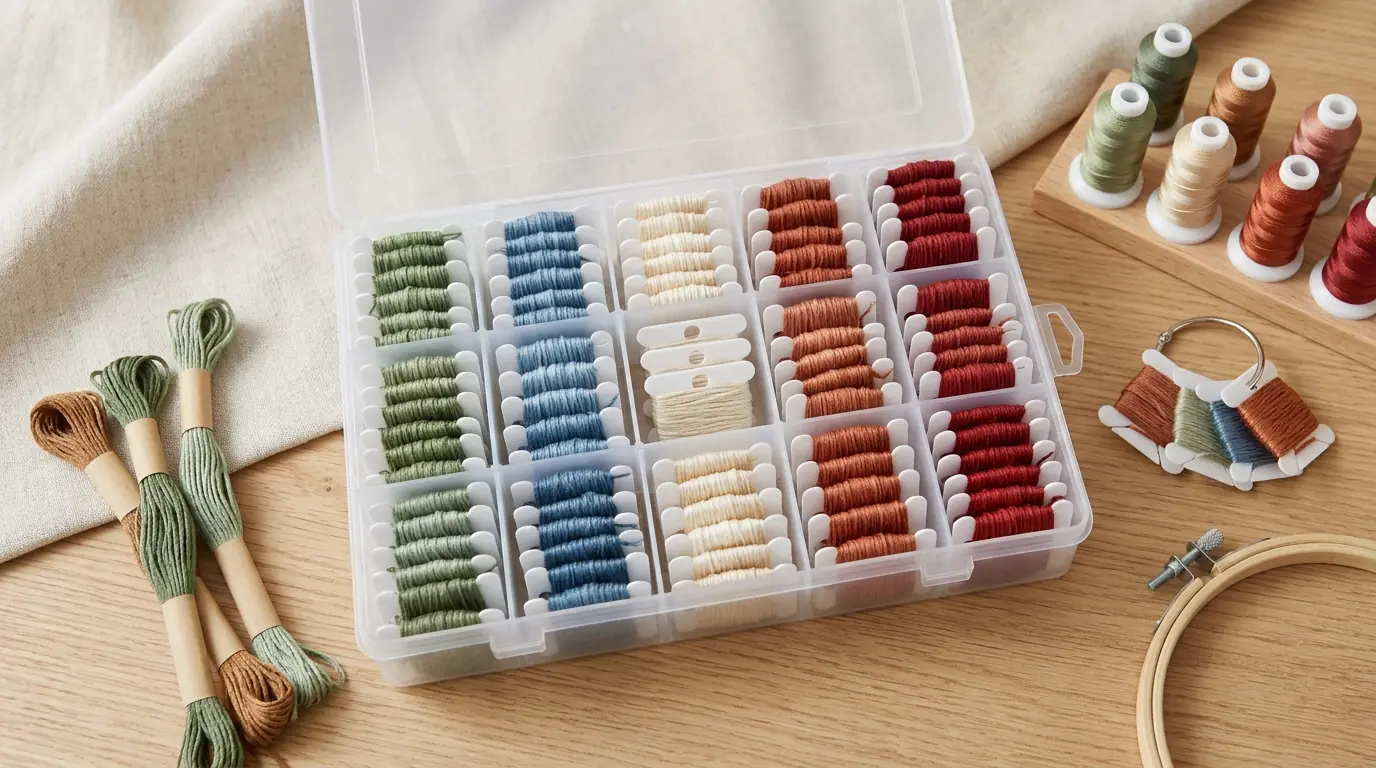
The Embroiderers’ Guild of America notes that some stitchers avoid plastic bobbins because they can stress and damage the thread; bags are their alternative. For shelf storage, binder pocket pages can hold wound bobbins or flat floss bags, as Hoop and Floss describes. Choose the bag version if you want to avoid winding, and check that the filled pockets and binder fit your shelf.
What each setup needs: bobbins, a compartment box and labels or a pen, plus time to wind each skein; bags need a pen and a box or ring, and the skein goes in whole. For a DIY option, cut bobbins or floss drops from stiff card and label them with the brand and color code.
Our running example: about 150 DMC colors, a dozen you use in almost every project, and 20 machine embroidery spools.

How do you organize embroidery floss on bobbins?
- Number first. Unmarked leftovers cannot be matched reliably later. Write the color number on the bobbin before you wind, with a permanent marker or a sticker; pencil smudges off plastic.
- Find the right end. Pull the floss slowly from the end under the larger label. If the skein bunches, try the other end.
- Wind loosely. Do not pull tight; tight winding can leave bends that are harder to stitch out.
- Secure the end. Slip the last bit into the bobbin’s slot so it does not unwind.
- File by number. Stand the bobbins upright in number order.
Sort by number, not color: patterns list colors by number, and DMC color numbers are not arranged as a continuous rainbow. Give codes that are not plain numbers, such as BLANC, ECRU and B5200, a fixed place, for example at the front of your DMC collection. Keep brands and thread lines apart, too: a number means something only inside its brand.
How many floss boxes and bobbins do you need?
Plan one bobbin per color. DMC rates its storage box, ref. 6118U, for 100 wound bobbins. We plan 80 per box as a buffer for new colors; that is our planning assumption, not a tested capacity. DMC sells plastic bobbins 28 to a pack.
- Boxes = colors ÷ 80, rounded up. For a different box, use its stated capacity and leave the reserve you want.
- Bobbin packs = (colors − usable bobbins you already own or receive with your boxes) ÷ 28, rounded up; zero if you already have enough. Check what comes with the box before buying extras.
| Colors you own | Boxes (80 planned per box) | Packs, starting with no bobbins | Packs if you own 50 bobbins |
|---|---|---|---|
| 50 (DMC’s best-seller pack) | 1 | 2 | 0 |
| 150 (our example) | 2 | 6 | 4 |
| 250 | 4 | 9 | 8 |
| 493 (the color options on DMC’s floss page) | 7 | 18 | 16 |
In the example, two boxes give room for about 160 bobbins at our planning fill. Starting from scratch, six packs give 168 bobbins; with 50 usable bobbins already in a drawer, four packs cover the rest. If your box is rated for 50 bobbins and you plan 40 per box, 150 colors need 4 boxes.
How do you store floss skeins without winding?
Put each skein in a small zip bag with the number written on it, and leave the paper bands on. File the bags upright in a box in number order, or hang them on a large ring. Bags take more space than bobbins, but you skip winding and the floss stays uncreased. For a small collection or spare skeins, whole skeins can also go straight into a drawer; leave both labels on.
Where do the colors you use most go?
Colors you use a lot need more room than one slot. Keep one bobbin per color in its number slot, and file extra skeins in individual numbered bags or behind labeled dividers in a separate box. DMC’s Top 50 pack, its best-sellers, is a reference point; the colors you actually reach for decide your spares.
How do you keep track of what you own and where it is?
Track two things separately: where the working bobbin is, and how many spare skeins you have. Copy this table into a note or spreadsheet; the rows are an example, not a tested method:
| Brand | Code | Working thread location | Spare skeins | Buy next |
|---|---|---|---|---|
| DMC | 310 | Project bag “Sampler” | 1 | No |
| DMC | 321 | Main box | 0 | Yes |
When a project ends, change the location back to “Main box”, and set “Buy next” for any color you used up. Take the list when you shop to avoid buying a color twice.
How do you keep floss from tangling during a project?
Pull only the project’s colors from the stash; stitching straight from the box is how colors go missing. If your bobbins have a hole, put them on one binder ring; otherwise use a small project box or labeled bags. Write the chart symbol next to the number if your pattern uses symbols. This set is also your travel kit.

To buy only the floss a pattern needs, use the Cross Stitch Calculator; besides fabric size, it estimates floss skeins per color. Your hoop goes with the project too; see our embroidery hoop sizes guide.
A reader on Needle ’n Thread asked how to store skeins after some thread has been used. Keep the color band attached; if the skein no longer stays tidy, move it to a labeled bag or bobbin.
How do you store machine embroidery thread?
Madeira advises keeping machine embroidery thread cool, dry, and protected from dust, heat, direct sunlight and humidity.
- Fitted spool cases. Madeira’s cases are made for specific spools, such as 12, 16 or 48 spools of 1100 yd. If all 20 spools in our example match that 1100 yd format, one 48-spool case has enough positions. Check the height and width of your spools before buying.
- Divided drawers. Shallow drawers with dividers keep spools upright and dark.
- A rack for daily spools. Put it inside a closed cabinet, and cover it when not in use.
Amann recommends “first in, first out”: new spools go behind the old ones.
Should thread be on display or behind a lid?
Behind a lid for the stash. The Embroiderers’ Guild of America warns that light bleaches colors on open wall displays, and Coats advises against leaving containers lying around with the lids off.
| Option | Light | Dust | Best use |
|---|---|---|---|
| Opaque lidded box or closed drawer | Blocks light while closed | Reduces dust | Long-term stash |
| Clear box with lid | Lets light through | Reduces dust | Inside a closed cupboard |
| Rack or pegboard | Exposed | Exposed | Active spools inside a closed cabinet; cover when not in use |
For shelves and cabinets for the whole room, see our craft room storage ideas.
Does embroidery thread go bad?
The sources checked here do not give a universal expiry date for all embroidery thread. Amann reports no known adverse effects on its own threads under normal storage conditions and suggests storing them not above 25°C (77°F) if possible. Coats warns that excessive UV and poor storage can reduce strength or fade some shades.
Avoid damp or condensation-prone spots. For old thread of uncertain storage history, try a short length before committing to a project; this is a practical check, not a guarantee. Fabric wants similar conditions; see our fabric storage ideas.
How we research
We have not tested these products. This guide draws on storage advice from the thread makers Amann, Coats and Madeira, DMC’s product pages, the Embroiderers’ Guild of America and stitching guides, all linked in the sources. The box and bobbin counts are our own calculation from DMC’s figures.
Before you buy anything
Sources
- DMC US: Six-Strand Embroidery Floss, ref. 117MC, 100% cotton, 8.7 yard / 8 meter skeins; the product page offers 493 color options (its marketing text says 500 shades). (retrieved 2026-11-08)
- DMC US: Top 50 Floss Color Pack, best-selling colors, including 310, BLANC, ECRU, 3865 and B5200. (retrieved 2026-11-08)
- DMC US: Plastic bobbins, 28 per pack, with space for the color number. (retrieved 2026-11-03)
- DMC US: Bobbin winder page; DMC also sells a storage box, ref. 6118U, which holds 100 bobbins wound with embroidery thread. (retrieved 2026-11-03)
- Madeira USA: Thread storage. Plastic spool cases holding 12, 16 or 48 spools of 1100 yd, a cone/spool holder and spool chests. (retrieved 2026-11-08)
- Madeira USA: Classic Rayon. Store machine embroidery thread in a cool, dry place, protected from dust, heat, direct sunlight and humidity. (retrieved 2026-11-08)
- Amann Knowledge Hub: Sewing thread storage. Cool, dry and dark, in the original packaging, protected from dirt, direct sunlight, high humidity and chemicals, first in, first out; under normal storage conditions no known adverse effects on quality. (retrieved 2026-11-08)
- Coats: Thread storage. Clean, dust-free storage, no direct sunlight, lids kept on containers; bad storage can cause loss of strength from UV and fading of non-fast shades. (retrieved 2026-11-08)
- House of Needelier: how to organize embroidery floss. DMC colors identified by number, such as 310 (black); bobbins usually have a hole for a ring; label first, pencil smudges off plastic; wind loosely; slip the end into the slot so the floss does not unwind; DMC numbers do not follow color families; floss drops. (retrieved 2026-11-08)
- Hoop and Floss: how to store embroidery floss; bobbins, drops, bags and binders compared. Pull floss from the end under the larger label and leave both labels on; bags take more space but need no winding; floss drops on a ring suit kits and pre-cut lengths; binder pages hold bobbins or flat bags; Blanc, B5200 and Ecru at the front; a number means something only inside its brand, keep brands apart; DIY bobbins and drops from stiff card. (retrieved 2026-11-08)
- Embroiderers' Guild of America: tips for organizing a big embroidery stash. Some stitchers avoid plastic bobbins because they can stress and damage the thread and use small resealable bags instead; light exposure bleaches colors on open wall displays. (retrieved 2026-11-08)
- Needle 'n Thread: Embroidery thread storage and organization (2012); reader comments ask how to store skeins after some thread has been used; the answer: keep the number tag on; numbered bags for part skeins. (retrieved 2026-11-08)