
Craft room · Fabric storage
Fabric Storage Ideas: How to Store Fat Quarters, Scraps, Yardage and Precuts
A fat quarter, a bag of scraps and four yards of backing need different homes. Sort by piece size first, then pick the container, the fold and the label.
The short answer
Sort your fabric by piece size first. Scraps go in lidded bins. Fat quarters are folded and stood on edge in a drawer. Yardage is wrapped on boards and shelved like books. Wide backings can be loosely folded in a large bin or rolled on a prepared tube. Then put all of it behind a door or a lid, somewhere dry and out of the sun.
Most fabric storage goes wrong the same way: one big bin, and the piece you need at the bottom. The fix is sorting by piece size, because a 2 in strip, a fat quarter and four yards of backing fold and stack differently. This guide covers the fabric itself. For shelves, carts and the layout of the whole room, see our craft room storage ideas.
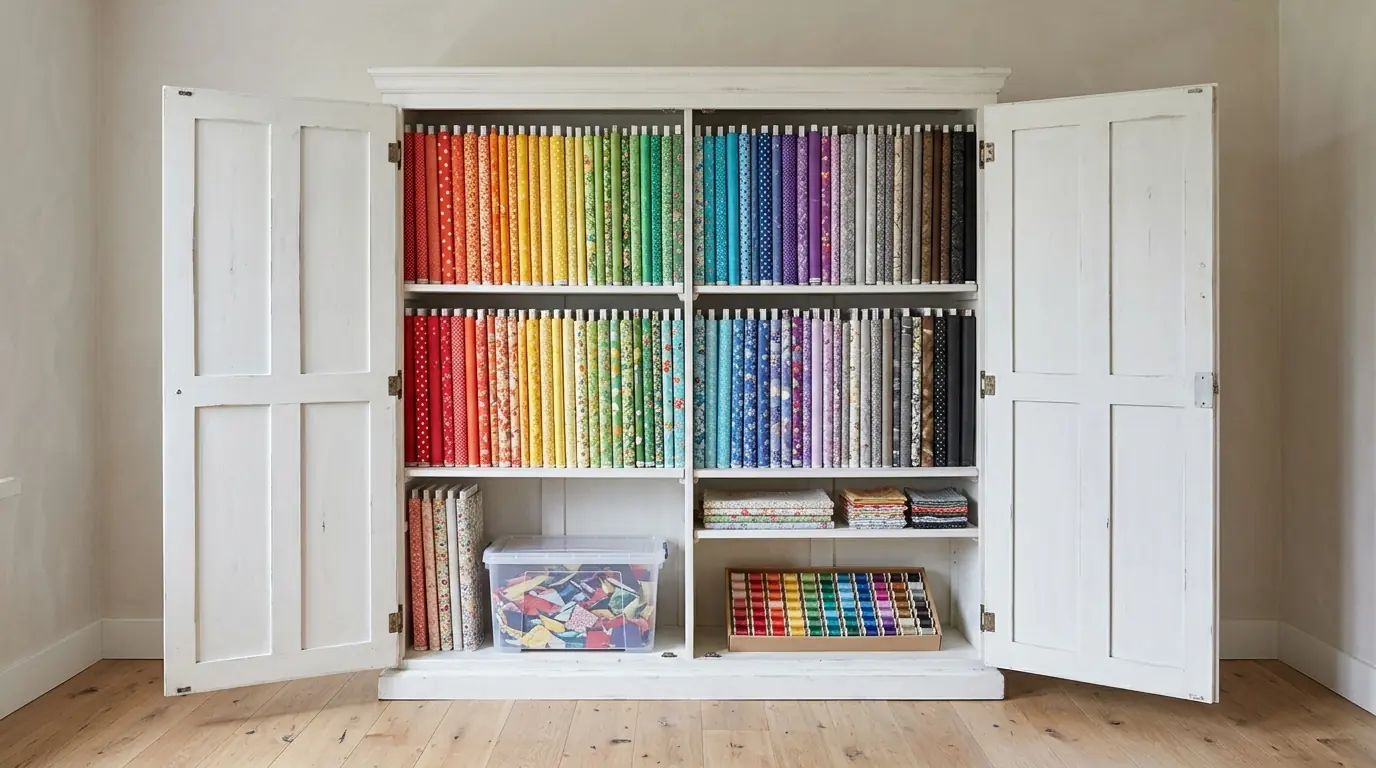
The system is built around quilting cotton. Wider apparel fabric gets its own fold in the comic board section. Knits and bulky fabrics such as fleece go loosely folded into large lidded bins; knits stretch when hung, so fold them.
To keep it concrete, say your stash is 20 fat quarters, a shoebox of scraps, one jelly roll, 3 yards of a blue floral quilting cotton and 4 yards of a 108 in wide back. We will follow it through the guide.
Fabric storage ideas at a glance
Eight ideas, each explained further down:
| Idea | Best for | Main drawback | Works with what you own |
|---|---|---|---|
| Comic boards on a bookcase | Yardage you want to browse by print | Needs shelf space; not for wool or silk | Any bookcase or cabinet with doors |
| Mini bolts | Yardage or fat quarters you want clipped and labeled | Bought by the pack | The same shelves as comic boards |
| File-folded fat quarters | Fat quarters you want to see at a glance | The fold has to suit the drawer height | Any drawer or shoebox |
| Clear latching boxes | Scraps you sort by size group | Clear plastic lets light in | Lidded boxes you already have, inside a cupboard |
| Precut boxes | Precuts you keep wrapped until a project | One more box per pack shape | Any lidded box the pack fits |
| Project boxes | A quilt you have planned but not started | Fabric is out of sight of the stash | Any lidded box |
| Rolled backings | Wide backs you want with fewer creases | Needs a long box and a tube | Under-bed space, a covered cardboard tube |
| One-page inventory | Knowing what you own before you shop | Only works if you update it | A notebook or a spreadsheet |
A common mistake is the pretty open display on a ladder or open shelves by a window, where light and dust reach every folded edge. Everything below assumes a door or a lid.
Fabric storage ideas by piece size
Start with five piles: scraps, fat quarters, precuts, yardage and wide backs. Measure as you go; you will need the numbers for the labels.

| Piece | Typical size | Best storage |
|---|---|---|
| Scraps | Smaller than a fat eighth | Lidded bins by size group |
| Fat quarters and fat eighths | About 18 × 22 in (46 × 56 cm) and 9 × 22 in (23 × 56 cm) | File-folded in a drawer, or on small mini bolts |
| Precuts | 2 1/2 in strips, 5 in and 10 in squares | Wrapped, in a box sized to the pack |
| Yardage | About 1/2 yard and up, 42 to 44 in (107 to 112 cm) wide | On comic boards or mini bolts, like books |
| Wide backs | 108 in (274 cm) wide | Loosely folded in a large bin, or rolled |
Quilting cotton runs about 41 to 45 in wide, so a fat quarter can be 18 × 20 in rather than 18 × 22 in. Measure yours.
How to store fat quarters
A flat stack of fat quarters only shows you the top print. Stand them up instead.

- File-fold them. Fold the fat quarter in half with the two 22 in edges together, so it is about 9 × 22 in. Fold that in thirds (about 9 × 7 1/4 in), or in quarters (about 9 × 5 1/2 in) for a shallow drawer. Stand it on the long edge where the last flap ends, so the raw end sits at the bottom and a clean fold faces up. Standing up, thirds need about 8 in (20 cm) of free drawer height and quarters about 6 in (15 cm). Fold one and test it in your drawer.
- Use small mini bolts. The Fat Quarter Shop 4 × 6 in Fat Quarter Mini Bolts are acid-free boards for pieces under 1 yard. Wrap, clip and stand them in a box or on a shelf.
- Keep bundles together. A bundle bought for one quilt goes in that project’s box.
The 20 fat quarters in the example, folded in thirds, would likely fit one standard drawer, light colors at the front; test one fold first. Fat eighths fold the same way, with one fold fewer.
Precuts: jelly rolls, charm packs and layer cakes
Precuts are already sorted, so the job is not to undo that.
Leave them wrapped until you start, store them by type in lidded boxes that fit the pack, and stack layer cakes flat. Reroll an opened jelly roll with its ribbon.
The jelly roll in the example would stay wrapped, in the project box with the pattern it was bought for.
Fabric scrap storage that you will actually use
Scraps are only useful if you can find a size quickly. Sort each piece by asking three questions, in this order:
- Is it roughly fat-eighth size or larger? Fold it and file it with the fat quarters.
- Is it a long strip? Strips go in one bin, rolled or folded over a ruler, for binding and string blocks.
- Is it bigger than your palm? Then it is a chunk. Sort chunks by color family into lidded boxes.
Anything smaller that you would not cut into is not a scrap you need to store. A clear box such as the Sterilite 15 Qt. Latching Box shows the colors without opening it. Sterilite says its products are polypropylene and polyethylene, with no PVC; the Canadian Conservation Institute (CCI) warns that plasticizers can migrate out of PVC.
In the example, the shoebox of scraps might become one strip bin and two color boxes.
How to store fabric yardage
Yardage is where folding matters most. CCI’s advice for textiles is few folds, limited stacking and rolling for large pieces, because sharp creases put fibers under stress. A wrapped board means fewer folds, less pressure from a pile and easier access. Fat Quarter Shop Original Mini Bolts (7.5 × 11.75 in, with a clip) hold 1 to 15 yards each, the shop says; comic boards do the same job.
Stand the boards on a shelf like book spines, sorted by color or by project, behind doors. If the shelf is bare wood, lay a sheet of polyethylene under the boards; CCI advises sealing or covering wood used for textile storage.
The comic board method, step by step

BCW Current Comic Backing Boards are 6 3/4 × 10 1/2 in (17 × 27 cm) and acid-free. Other comic sizes vary a little; BCW’s Golden Age boards, for example, are 7 1/2 × 10 1/2 in.
- Fold selvage to selvage. A 42 to 44 in wide cotton becomes 21 to 22 in.
- Fold again. Now it is 10 1/2 to 11 in wide, about the height of the board.
- Wrap. Lay the board at one end and wrap the fabric around it with gentle tension, not tight.
- Pin and label. Pin the end with a flat pin or a clip and write the fiber, yardage and width on a tag. You will not need to remeasure before every project; update the tag when you cut.
The 3 yards of blue floral in the example would go on one board, with a tag reading “Blue floral, cotton, 3 yd × 44 in, prewashed.”
The fabric can stand a little above the board, so measure one wrapped board before you buy shelves. A 60 in apparel fabric folded twice is about 15 in, too tall for the board; fold it in thirds after the selvage fold, or use a larger board.
Rolling wide backs and large pieces
A wide back is commonly 108 in (274 cm) wide, too wide for a board. Loose folding in a large lidded bin is a normal choice; a tube gives fewer creases. For everyday quilting cotton, folding the width before rolling is a space-saving compromise. CCI’s conservation method rolls textiles unfolded on a tube wider than the fabric.

- Fold the width (household version). Fold the 108 in width loosely in thirds, to about 36 in. The length stays as it is.
- Cover the tube. CCI recommends wrapping a cardboard tube in polyester (Mylar) or polyethylene film, then in unbuffered tissue or prewashed cotton, so the cardboard never touches the fabric.
- Roll print side up. For flat fabric, CCI says to roll with the right side up, so it ends up on the inside. Only napped fabrics such as velvet roll pile out.
- Support the tube ends. Inside the box, rest the ends on blocks or rolled towels so the roll does not lie on its own weight.
For the folded household version, choose a tube longer than the folded width, leaving both ends clear for support. Measure the tube and supports against your box before buying. The 4 yard wide back in the example would fit one such box. To see how much wide back a quilt needs, use the Quilt Backing Calculator.
Light, dust and damp
Fabric you use and rotate needs simple, protected storage; precious or long-stored pieces deserve the more careful conservation steps.
Light damage adds up and does not reverse. CCI’s tables show the most sensitive dyes can start to fade within weeks under bright light, and you cannot tell which prints those are.
- Lids stop dust, not light. A clear box keeps dust off but lets light through, so keep clear boxes in a closet or cabinet. Doors, opaque boxes and drawers keep out both.
- No storage in direct sun, even behind glass. Most white LEDs give off almost no UV, according to CCI, so room light is gentler than daylight.
- Keep it dry. Persistent damp encourages mold, so avoid damp basements and cabinets against cold exterior walls.
Thread wants the same dry, dark, dust-free conditions, Aurifil advises; floss, bobbins and spool racks are covered in our craft room storage ideas.
Fabric storage ideas for small spaces
Measure the inside of each drawer, shelf and box first, and test one folded or wrapped sample before buying anything. Start with what you already have: drawers or shoeboxes for fat quarters, lidded boxes in a cupboard for scraps and precuts, and a cabinet with doors for boards once the yardage outgrows a box. Store rolled backings in long, lidded boxes under the bed. For the example stash, that could be one drawer, one cabinet shelf and one long box. Keep the fabric zone close to the cutting table and away from the window; our sewing room ideas hub shows how to lay out the zones.
Keep a fabric inventory
An inventory does not need an app: one label on each piece and one line on a list, with the same facts.
- On the piece. Print, fiber, yardage, width and “prewashed” if it is: “Blue floral, cotton, 3 yd × 44 in, prewashed.”
- On the list. The same facts, plus where the piece lives. Copy this table into a note or spreadsheet:
| Fabric | Fiber | Length | Width | Prewashed | Where it lives |
|---|---|---|---|---|---|
| Blue floral | Quilting cotton | 3 yd | 44 in | Yes | Cabinet 2, shelf 3 |
- Photos. A photo of each shelf lets you check your stash from the shop.
Update the tag and the list when you buy or cut. Before you buy for a project, compare the list with what the pattern needs; the Quilt Calculator works out backing, binding and batting if the pattern does not.
How we research
We have not tested these products. This guide draws on Canadian Conservation Institute guidance, maker and shop pages, Aurifil’s thread advice and quilt shop cut charts, all linked in the sources. Fold figures are our own calculations.
Before you reorganize your fabric
Questions people ask
What is the best way to store fabric?
Folded or wrapped with few folds, in closed storage that is dry, cool and dark. The Canadian Conservation Institute's textile advice is few folds, limited stacking and rolling for large pieces.
How do you store fat quarters?
Fold them in half and then in thirds, and stand them on edge in a drawer with the raw end down, or wrap them on small fat quarter mini bolts. Either way you see every print from above.
Are comic boards safe for fabric?
BCW's current boards are acid-free and buffered with calcium carbonate. They are a practical choice for quilting cotton you use and rotate. For heirloom or long-term pieces, and for wool and silk, use unbuffered, archival supports.
How do you sort fabric scraps by size?
Ask in order: roughly fat-eighth size or larger? File with the fat quarters. Otherwise, is it a long strip? Strip bin. Otherwise, bigger than your palm? Color box. Keep smaller pieces only if you have a use for them.
How should you store precuts like jelly rolls and charm packs?
Leave them in their wrapping until you start the project, and keep them flat or upright in a lidded box sized to the pack. Opened precuts go back with ribbon or a band around them.
How do you store fabric in a small space?
Start with the drawers and lidded boxes you already have, add a cabinet with doors for boards when the yardage outgrows them, and store rolled backings in long, lidded boxes under the bed.
How do you keep track of a fabric stash?
Put the same line on the tag and on a simple list: print, fiber, yardage, width, prewashed or not. The list also says where the piece lives. Update both when you buy or cut.
Sources
- CCI: Caring for textiles and costumes. Few folds padded with acid-free tissue, sharp creases can fracture, limit stacking, roll large pieces, knits stretch when hung, avoid PVC, inert plastic boxes lined with tissue; time to a just noticeable fade for high-sensitivity dyes at 500 lux with UV, 5 weeks to 1 year; UV is absent in most white LEDs. (retrieved 2026-11-03)
- CCI Note 13/1: Textiles and the Environment. Light damage is cumulative; mold at 70% RH in 3 months or more. (retrieved 2026-11-03)
- CCI Note 13/3: Rolled Storage for Textiles. Tube longer than the textile is wide; cover cardboard with Mylar or polyethylene sheeting, then unbuffered tissue or prewashed cotton; buffered materials can damage wool and silk; roll flat textiles right side up so they roll inwards, pile fabrics pile out; support the tube so the textile does not bear its own weight. (retrieved 2026-11-07)
- BCW: Current Comic Backing Boards, 6 3/4 x 10 1/2 in, 24-point solid bleached sulfate, certified acid-free, buffered with 3% calcium carbonate on one coated side, 100 per pack; Golden Age boards on the same page listed at 7 1/2 x 10 1/2 in. (retrieved 2026-11-07)
- Fat Quarter Shop: 50 Pack 7.5 x 11.75 in Original Mini Bolt fabric organizers, acid-free, archival, built-in clip, hang hole, each holds 1 to 15 yards. (retrieved 2026-11-03)
- Fat Quarter Shop: 50 Pack 4 x 6 in Fat Quarter Mini Bolt fabric organizers, acid-free, for pieces smaller than 1 yard. (retrieved 2026-11-03)
- Sterilite FAQ: products made from polypropylene and polyethylene, no PVC; many clear products are acid-free and safe for storing fabrics. (retrieved 2026-11-03)
- Sterilite: 15 Qt. Latching Box, model 1494, 16 1/4 x 11 1/4 x 6 3/4 in, clear base and lid. (retrieved 2026-11-03)
- Nuts and Bolts Fabric: guide to fat cuts. A yard is 36 in long; quilting cotton about 42 to 44 in wide, 60 in for some apparel fabrics, 108 in for wide backs; fat quarter about 18 x 22 in, fat eighth about 9 x 22 in, quarter yard about 9 x 44 in. (retrieved 2026-11-04)
- Bloomerie Fabrics: pre-cut fabric sizes. Quilting cotton widths vary from 41 to 45 in, so fat quarters can measure 18 x 20 in or 18 x 22 in. (retrieved 2026-11-04)
- Aurifil (auribuzz): Thread basics, part 2. Store cotton thread away from dust and direct sunlight in a cool, dry space, in closed containers or cases. (retrieved 2026-11-04)
- Fat Quarter Shop: precut fabric categories. Fat quarter bundles 18 x 21 in, jelly rolls 2.5 in strips, layer cakes 10 in squares, charm packs 5 in squares. (retrieved 2026-11-07)