
Knitting & Crochet · Guide
Crochet Plant Pot Cover: How to Measure, Choose Yarn and Estimate Yardage
Measure the pot you have, pick a pattern that matches its shape, swatch, then estimate yarn. A cover is décor — the plant still needs drainage.
The short answer
Measure the top, the bottom and the height of the pot you will cover. Pick a pattern that matches that shape and an open or closed base. Swatch, then estimate yarn from a published amount or from the side area, and buy whole balls from one dye lot.
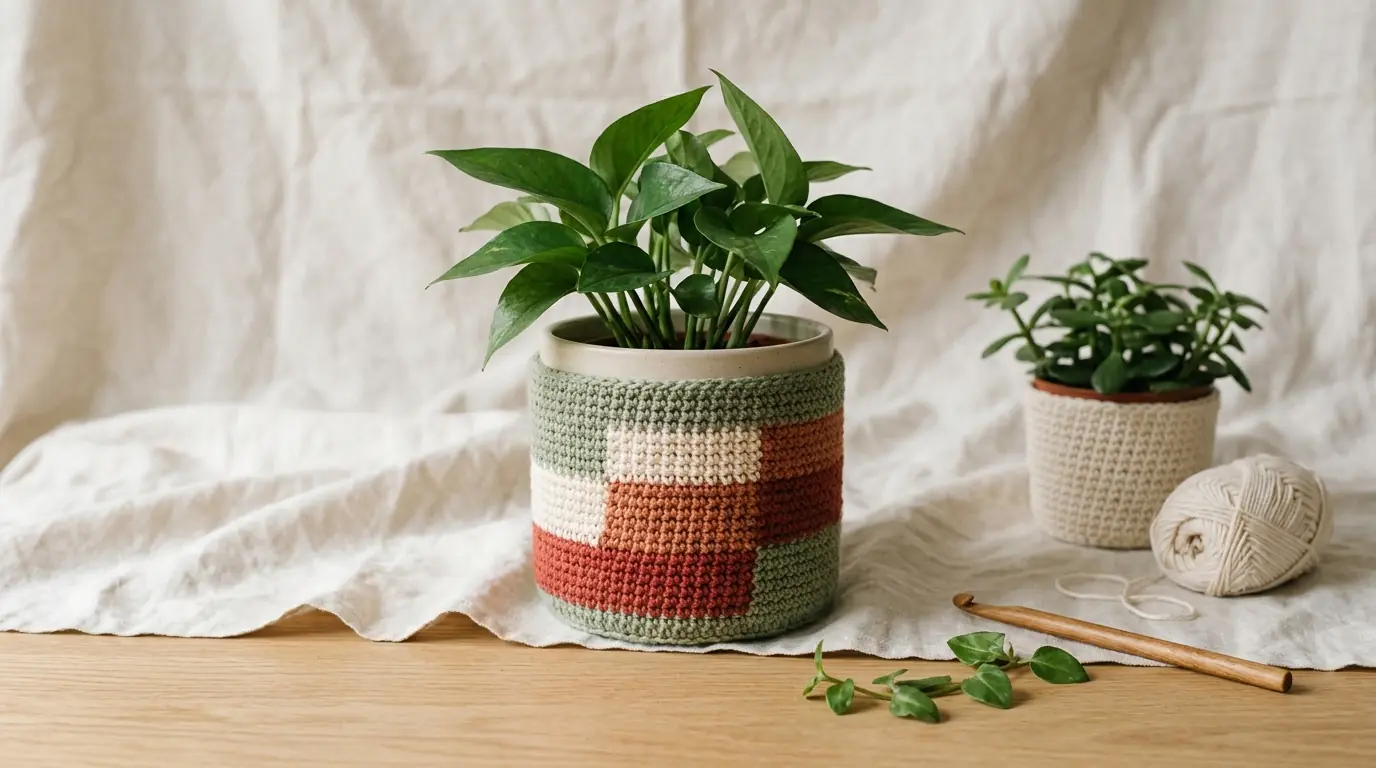
A crochet plant pot cover is a sleeve — with or without a fabric floor — that slips over a nursery pot or a plain planter. It is décor, not a stand-in for a pot with holes. Measure the pot, pick a pattern that matches the shape and the base you want, swatch, and then estimate yarn.
Measure the pot, not just the label

Take these readings on the pot you will actually cover:
- Top diameter — across the rim. Nursery pots sold as 4 in, 6 in or 8 in are named this way.
- Bottom diameter — across the base. The Ridged Pot Cozy, written for a 6 in (15 cm) pot, lists a 6 in top and a 4 in (10 cm) bottom.
- Straight height — from the table to the rim, not along the side.
- Slant height — the side wall, or the square root of the height squared plus half the difference of the two diameters, squared.
When top and bottom match, the slant equals the height — the way Peppermint Twist is written (6 in by 6 in). Chain about the circumference times your stitches per inch, join, and work even. Multiply a diameter by pi (about 3.14) to get that circumference. The Ridged pattern starts with 48 chains at 14 single crochets per 4 in (about 4.4 in across) and finishes at 80 stitches (about 7.3 in across).
The same habit of measuring what you cover shows up in other crochet home decor projects, such as lampshade covers and chair pads.
Pick a construction that still drains

- Open-bottom sleeve. Chain a ring and work up, increasing if the pot tapers. The Ridged Pot Cozy and Peppermint Twist bases are open “to allow drainage.”
- Closed-bottom basket. Work a flat circle, then turn up the sides. The Hanging Pot Cozy and the Pot Pals start at the center, so fabric sits under the pot.
- Squares and color blocks. Seam granny squares into a tube, or work tapestry blocks, and fit the tube to the top circumference.
For a plain textured sleeve, start with the Ridged Pot Cozy. Peppermint Twist is a two-color open stripe; Blooming Season is a short cover in bulky wool. For a decorative cover, Little and Large add trim or fringe, Pot Pals are animal shapes, and the Hanging Pot Cozy adds cording. Granny squares or the block grid below are the custom route.
If you use Blooming Season, trust the circumference and the centimetre resize on that page. The overview writes the 35 cm size as a diameter, and the inch example does not match the stated gauge; the source note at the bottom has the arithmetic.
Keep the growing pot, the one with holes, from sitting in runoff — Nebraska Extension mentions a layer of pebbles in an outer container as one method. After watering, Wisconsin Horticulture says to wait 10 to 20 minutes and empty the saucer; Maryland Extension says never to let houseplants sit in water.
A worked example: 15 cm top, 10 cm bottom, 15 cm high
The pot is 15 cm (5.9 in) across the top, 10 cm (3.9 in) across the bottom, and 15 cm (5.9 in) tall.
Circumferences. The top is about 47 cm around (18.6 in); the bottom is about 31 cm (12.4 in). The average circumference — the width of the side if you unroll it — is about 39 cm (15.5 in).
Slant height. Because the wall leans, the side is a little longer than the straight height: about 15.2 cm (6.0 in).
Area. Average circumference times slant is about 93 square inches. That is the rectangle to think of as fabric.
Starting stitches. At 14 single crochets per 4 in, that is 3.5 stitches per inch. An open sleeve that slips over the base starts with about 43 stitches and grows to about 65 at the rim. A straight cylinder that splits the difference would use about 54 stitches all the way up.
Yarn estimate. Scaled from the Peppermint Twist 106-yard figure (two colors, carries the unused strand), this pot needs about 87 yards — only with the same color technique and a comparable yarn. A single-color sleeve should need less; treat about 87 yards as a ceiling.
In the Yarn Calculator. Choose From my swatch, not the blanket estimate. Enter Swatch width and Swatch height, then Yarn used in the swatch or Swatch weight. Set Finished size to Custom size, Width to 15.5 in (average circumference) and Length to 6.0 in (slant). Add Length per skein from the ball band. Under More options, try a Safety margin of 10%, and optionally Add 1 spare skein from the same dye lot.
If you knit a cover instead, the same three measurements apply. The Knitting Calculator turns a swatch into a cast-on count for the circumference.
Yarn: cotton, acrylic and wool
Worsted (4) is the usual weight (about 11 to 14 single crochets per 4 in, as a Craft Yarn Council guideline). Lily Sugar’n Cream is 100% cotton: 120 yards (109 m) per 71 g (2.5 oz) ball, washed on a delicate setting not exceeding 86 F (30 C). Red Heart Super Saver is 100% acrylic, machine wash in warm water, 364 yards (333 m) in a 7 oz (198 g) skein. DROPS Snow is hand-wash wool, about 55 yards (50 m) per 50 g, sold as feltable; two balls cover the published Blooming Season size.
Change hook size until the swatch matches (these patterns use 3.75 mm, 4 mm, 4.5 mm, 5 mm or 6 mm). When you substitute yarn, match yards or meters, not ball weight, and still check gauge.
How much yarn: published amounts and a limited scale

Pattern rows quote the PDFs; the cylinder rows are our own scale. Peppermint Twist uses 106 yards (55 plus 51) for a 6 × 6 in open cylinder and carries the unused strand, so that total includes yarn that never shows on the front. Scaled by area, a 4 × 4 in cylinder is about 47 yards and an 8 × 8 in cylinder about 188 yards — only with the same color technique and a comparable yarn, not for a single-color cover or granny squares. A two-color cozy is not one 120-yard ball just because the total sits under 120 yards; you still buy one ball of each color.
| Pattern | Size | Total yarn | Per color | Balls to buy |
|---|---|---|---|---|
| Hanging Pot Cozy | 4 1/2 in (11.5 cm) | 68 yards | 57 and 11 yards | 1 of each color; plus 40 in of 1/4 in cording |
| Pot Pals | 4 1/2 in (11 cm) | 71, 66 or 64 yards | Not stated | 1 ball per pal |
| Blooming Season | 35 cm around, 12.5 cm tall | 110 yards | 50 g each | 1 of each color |
| 4 × 4 in cylinder (our scale) | 4 × 4 in (10 × 10 cm) | About 47 yards | About 24 and 23 yards | 1 of each color (two-color method) |
| Ridged Pot Cozy | 6 in top, 4 in bottom | 84 yards | One color | 1 ball (120-yard cotton) |
| Peppermint Twist | 6 × 6 in (15 × 15 cm) | 106 yards | 55 and 51 yards | 1 of each color (6 cozies per pair) |
| Little Potted Plant Cozy | 6 3/4 × 6 1/2 in | 186 yards | 120 and 66 yards | 1 main-color ball plus 1 contrast |
| 8 × 8 in cylinder (our scale) | 8 × 8 in (20 × 20 cm) | About 188 yards | About 98 and 91 yards | 1 of each color (two-color method) |
| Large Potted Plant Cozy | Pot 11 1/2 × 10 1/4 in; cozy 8 1/4 in tall without fringe | 356 yards | Not stated | 3 balls |
The Ridged PDF does not state a height: 28 single-crochet rounds are about 8.0 in (about 8.3 in if you count the last slip-stitch round). Patterns were checked on 6 November 2026. The Large cozy PDF mentions optional glue; a washable cover is better left removable.
From ceramic Tetris pots to a color-block cover
This URL first held a short interior-design note, not a crochet pattern. An archived copy from 28 May 2009 describes ceramic plant pots shaped like Tetris blocks, with pastel-painted insides. The idea was made for a ceramic course; the model was too big and the result was not satisfying, so it stayed a 3D model waiting for a go-ahead to production.
A crochet cover can echo that blocky look. Stripes alone will not do it: plan a grid, then fill it with tetromino shapes (I, O, T, L, J, S and Z — four squares each).

- Unroll the cover as a rectangle: average circumference by slant. For the pot above, about 15.5 in by 6.0 in (39 cm by 15.2 cm).
- Choose a block size. Squares of 1.5 in give about 10 blocks around and 4 high — a 10-by-4 grid, or ten four-block pieces.
- Turn gauge into stitches. At 14 single crochets and 15 rows per 4 in, each 1.5 in block is about 5 stitches wide and about 6 rows tall.
- Color the grid with tetromino pieces before you hook, so blocks do not merge into stripes.
- Work the fabric. Tapestry carries the unused color (thicker fabric, more yarn). Intarsia uses a bobbin per color area. Or crochet separate squares and seam them.
- Fit and finish. Match the tube to the top circumference. Leave the base open if the pot drains.
Typical mistakes
Most people only check the top diameter, but a 6 in nursery pot is often closer to 4 in at the base. Another miss is treating a two-color total as one ball: 106 yards in two colors still means a ball of each. A third is a closed-bottom cover on a pot you water in place. A fourth is skipping the swatch — 13 stitches per 4 in (Little cozy) and 14 stitches per 4 in (Ridged and Peppermint) do not share a chain count. A fifth is leaving water in the saucer.
More projects
For another crochet piece around the house, see the fried egg rug pattern guide.
Before you chain
Questions people ask
How do I measure a pot for a crochet plant pot cover?
Measure the outside top diameter, the base diameter and the straight height. The number on the pot is usually the top. The Ridged Pot Cozy, written for a 6 in (15 cm) pot, lists a 6 in top and a 4 in (10 cm) bottom.
How much yarn do I need for a crochet plant pot cover?
Published covers in the table range from 68 to 356 yards. The 106-yard Peppermint Twist figure includes a carried unused strand, so do not scale it onto a single-color cover or granny squares. Round up to whole balls from one dye lot.
What yarn works for a plant pot cover?
A washable cotton or acrylic is the practical pick. Sugar'n Cream is cotton and washes at a delicate setting, not exceeding 86 F (30 C). Super Saver is acrylic and machine washes in warm water. DROPS Snow is hand-wash wool, sold as feltable.
Should a crochet pot cover have a bottom?
Only if you want one. The Ridged Pot Cozy and Peppermint Twist bases are open to allow drainage. The Hanging Pot Cozy and Pot Pals start from a center ring, so fabric sits under the pot. An open base is safer for a pot with holes.
How do I water a plant that has a crochet pot cover on it?
Water until it runs out of the holes, then empty the saucer. Wisconsin Horticulture says to wait 10 to 20 minutes; Maryland Extension says never to let houseplants sit in water. Slip the cover off if it would soak.
Sources
- Yarnspirations: Ridged Crochet Pot Cozy, free pattern page. To fit a 6 in (15 cm) plant pot; bottom diameter 4 in (10 cm), top diameter 6 in (15 cm); open base for drainage; 1 ball of Lily Sugar'n Cream; hook U.S. F/5 (3.75 mm). Retrieved 2026-11-06
- Yarnspirations: Ridged Crochet Pot Cozy PDF (SCC0518-008314M). Gauge 14 sc and 14 rows = 4 in (10 cm); 1 ball or 84 yds (76 m); start with 48 chains, finish at 80 stitches after 29 rounds; base open to allow drainage. Retrieved 2026-11-06
- Yarnspirations: Peppermint Twist Plant Pot Cozy, free pattern page. To fit a 6 in (15 cm) diameter x 6 in (15 cm) high plant pot. Retrieved 2026-11-06
- Yarnspirations: Peppermint Twist Plant Pot Cozy PDF (RHC0518-031096M). Gauge 14 sc and 15 rows = 4 in (10 cm); Contrast A 55 yds (50 m), Contrast B 51 yds (47 m); 1 ball of each color makes 6 cozies; hook U.S. 7 (4.5 mm); open base; work until about 5 1/2 in (14 cm), then 2 rounds in A. The unused color is carried. Red Heart Super Saver 7 oz (198 g), 364 yds (333 m). Retrieved 2026-11-06
- Yarnspirations: Little Potted Plant Crochet Cozy PDF (SCC0518-026043M). About 6 3/4 in (17 cm) diameter x 6 1/2 in (16.5 cm) high; pot 6 3/4 in (17 cm) diameter x 6 3/4 in (17 cm) high; Main Color 120 yds (109 m), Contrast A 66 yds (60 m); gauge 13 sc and 14 rows = 4 in (10 cm); hook U.S. H/8 (5 mm). Retrieved 2026-11-06
- Yarnspirations: Little Potted Plant Crochet Cozy, free pattern page. Retrieved 2026-11-06
- Yarnspirations: Large Potted Plant Crochet Cozy PDF (SCC0518-026031M). 3 balls or 356 yds (323 m) of Lily Sugar'n Cream; pot 11 1/2 in (29 cm) diameter x 10 1/4 in (26 cm) high; finished cozy about 11 1/2 in (29 cm) diameter x 8 1/4 in (21 cm) high, excluding fringe; hook U.S. H/8 (5 mm). Retrieved 2026-11-06
- Yarnspirations: Large Potted Plant Crochet Cozy, free pattern page. Retrieved 2026-11-06
- Yarnspirations: Hanging Pot Cozy PDF (SCC0518-009824M). To fit a plant pot 4 1/2 in (11.5 cm) diameter; Contrast A 57 yds (52 m), Contrast B 11 yds (10 m); gauge 15 sc and 16 rows = 4 in (10 cm); hook U.S. G/6 (4 mm); 40 in (101.5 cm) of 1/4 in (6 mm) cording. Retrieved 2026-11-06
- Yarnspirations: Hanging Pot Cozy, free pattern page. Retrieved 2026-11-06
- Yarnspirations: Pot Pals, free pattern page. To fit a standard 4 1/2 in (11 cm) diameter plant pot. Retrieved 2026-11-06
- Yarnspirations: Crochet Pot Pals PDF (SCC0501-002130M). To fit a standard 4 1/2 in (11 cm) diameter plant pot; Cat 71 yds (65 m), Bunny 66 yds (60 m), Bear 64 yds (58 m); gauge 15 sc and 16 rows = 4 in (10 cm); hook U.S. G/6 (4 mm). Retrieved 2026-11-06
- Yarnspirations: Lily Sugar'n Cream The Original Yarn. Solids 71 g (2.5 oz), 109 m (120 yards); 100% cotton; crochet gauge 13 sc x 14 rows per 4 in (10 cm) with a 5 mm (U.S. H/8) hook; wash in water not exceeding 86 F (30 C) at a delicate setting. Retrieved 2026-11-06
- Yarnspirations: Red Heart Super Saver Yarn. 100% acrylic; machine wash in warm water (care line on the product page). Retrieved 2026-11-06
- DROPS Design: Blooming Season (DROPS Extra 0-1479), US-English pattern page. Crochet plant-pot cover in DROPS Snow; height about 12.5 cm (4 7/8 in); circumference about 35 cm (13 3/4 in); 50 g off-white and 50 g red; gauge 12 single crochets and 12 rows = 4 in (10 cm); hook 6 mm (U.S. J/10); start with 42 chains (7 repeats of 6 stitches); centimetre resize: circumference × 1.2, then a multiple of 6 (example: 40 cm × 1.2 = 48). Note on two lines that do not match the gauge: the overview writes '35 cm (13 3/4 in) in diameter', but the starting chain matches a 35 cm circumference (about 4.4 in across). The page also prints '15 in × 1.2 = 18'; that inch example does not match the gauge (1.2 is per centimetre; 12 sc / 4 in = 3 stitches per inch, or 1.2 × 2.54 = 3.05, so 15 in × 3 = 45, next multiple of 6 = 48). Retrieved 2026-11-06
- DROPS Design: DROPS Snow yarn. 100% wool; 50 g (1.8 oz) = about 55 yds (50 m); yarn group E / super bulky; hand wash, cold max 30 C (86 F); dry flat; feltable. Retrieved 2026-11-06
- Craft Yarn Council: Standard Yarn Weight System. Worsted (4) crochet gauge about 11 to 14 single crochets per 4 in; guidelines only. Retrieved 2026-11-06
- Craft Yarn Council: Hooks and Needles. Use millimeter sizing and change hook size to match gauge. Retrieved 2026-11-06
- Lion Brand Yarn support: How much yarn do I need for a particular pattern. When substituting yarn, match the length (yards or meters), not the ball weight; still check gauge. Retrieved 2026-11-06
- University of Nebraska–Lincoln Extension, Lancaster County: Choosing a Container for Houseplants. Drainage holes let excess water escape; if you use a decorative outer container, keep the inner pot from sitting in runoff (a layer of pebbles or similar in the outer pot is one method). Retrieved 2026-11-06
- Wisconsin Horticulture, University of Wisconsin Extension: Houseplant Care. Water until it seeps from the drainage holes; allow 10 to 20 minutes, then remove water from the saucer; do not let a plant stand in water unless it specifically requires that. Retrieved 2026-11-06
- University of Maryland Extension: Watering Indoor Plants. Irrigate so water drains from the bottom; empty saucers; never let houseplants sit in water. Retrieved 2026-11-06
- Internet Archive Wayback Machine: archived copy of this URL, captured 28 May 2009. The page describes ceramic plant pots shaped like Tetris blocks, with the inner part painted in pastel colors; the idea was made for a ceramic course, the model was too big and the result was not satisfying, and the design remained a 3D model waiting for a go-ahead to production. Retrieved 2026-11-06